How AI Customer Support Automation Improves Customer Experience in 2026
AI Customer Support Automation is transforming customer service in 2026. Businesses are using AI chatbots, automated ticket management and intelligent support systems to provide faster responses, improve customer satisfaction and reduce operational costs. Learn how AI-powered customer support helps organizations deliver better customer experiences while increasing efficiency and scalability.
BUSINESS AUTOMATION
Understanding AI Customer Support Automation
AI customer support automation refers to the integration of artificial intelligence technologies into customer service processes to enhance efficiency and improve the overall customer experience. By leveraging sophisticated tools such as machine learning, natural language processing (NLP), and data analytics, businesses can streamline customer interactions and provide timely solutions to their clients' needs.
Machine learning, a key component of AI customer support automation, allows systems to learn from data patterns and improve their responses over time. This means that as more customer interactions are processed, the system can predict customer inquiries and provide more accurate assistance. By continuously evolving based on historical data, machine learning algorithms can also identify common issues and suggest proactive solutions, thereby reducing the workload on human agents.
Natural language processing plays another significant role in AI-driven customer support. It enables machines to understand and interpret human language, allowing customers to interact with support systems using natural conversation. This capability makes interactions more intuitive, as customers can express their concerns in their own words rather than relying on predefined prompts. NLP helps in sentiment analysis as well, enabling the system to gauge customer emotions during interactions, which can guide the appropriate response.
Furthermore, data analytics supports these technologies by processing large volumes of customer data to uncover insights and trends. This analysis can lead to more personalized customer experiences, as organizations can tailor their responses and recommendations based on individual customer preferences and behaviors. When combined, these technologies create a robust framework for AI customer support automation, enhancing the quality of service and satisfaction for clients.
The Evolution of Customer Expectations in 2026
As we progress into 2026, customer expectations are evolving rapidly, influenced by a multitude of factors that have reshaped the market landscape. The accelerated pace of technological advancements has fundamentally altered how consumers perceive service quality and responsiveness. Today's customers are increasingly tech-savvy, expecting seamless interactions across multiple channels at any time of day. This fundamental shift raises the bar for businesses aiming to provide excellent customer experiences.
Additionally, the accessibility of information has transformed customer behavior. In an era where information is readily available at their fingertips, customers are well-informed and discerning. They evaluate products and services not only based on quality but also on the speed and efficiency of customer support. Consequently, businesses must adapt to these heightened expectations by implementing robust support systems capable of addressing inquiries and issues promptly.
Moreover, global events have had a profound impact on consumer behavior and expectations. The COVID-19 pandemic, for example, catapulted digital interactions to the forefront of customer service. Customers now expect businesses to provide comprehensive online support, including chatbots and AI-powered solutions capable of offering assistance 24/7. This evolution requires companies to invest in advanced customer support technologies that facilitate personalized service and create a memorable customer journey.
Personalization has emerged as a crucial element of customer interactions in 2026. Customers desire tailored experiences that resonate with their preferences and history. This has led to a growing demand for businesses to leverage data analytics, enabling them to anticipate customer needs and deliver relevant support proactively. As a result, the landscape of customer expectations is becoming increasingly sophisticated, necessitating companies to innovate their customer service strategies continuously.
Key Benefits of AI-Powered Customer Support
In recent years, the integration of artificial intelligence (AI) into customer support systems has revolutionized how businesses interact with their clients. One of the primary advantages of AI-powered customer support is its 24/7 availability. Unlike traditional support systems that operate within set hours, AI can provide continuous assistance, ensuring that customers receive timely help regardless of the time of day. This round-the-clock service is particularly beneficial for global businesses catering to customers across different time zones.
Another significant benefit is the accelerated response times provided by AI systems. These automated systems can process inquiries and provide solutions in mere seconds, compared to the longer wait times often experienced with human agents. This rapid response not only enhances customer satisfaction but also fosters a positive perception of the brand, as customers feel valued when their issues are resolved promptly.
Cost reduction is yet another advantage of implementing AI in customer support. By automating routine tasks and inquiries, businesses can minimize labor costs associated with hiring and training extensive support staff. This reduction in operational costs allows companies to allocate resources more efficiently while maintaining quality support services.
Moreover, the implementation of AI enhances customer satisfaction metrics. AI systems offer personalized and consistent responses, ensuring that customers receive accurate information tailored to their needs. This personalization leads to a better overall experience, which can be measured by improved customer feedback and loyalty rates.
Finally, AI-powered customer support increases the productivity of customer service teams. With AI handling repetitive queries, human agents can focus on more complex issues that require empathy and critical thinking. Consequently, this boost in productivity not only benefits employees but also leads to higher-quality service for customers.
Exploring AI Chatbots, Ticket Automation, and Smart Service Systems
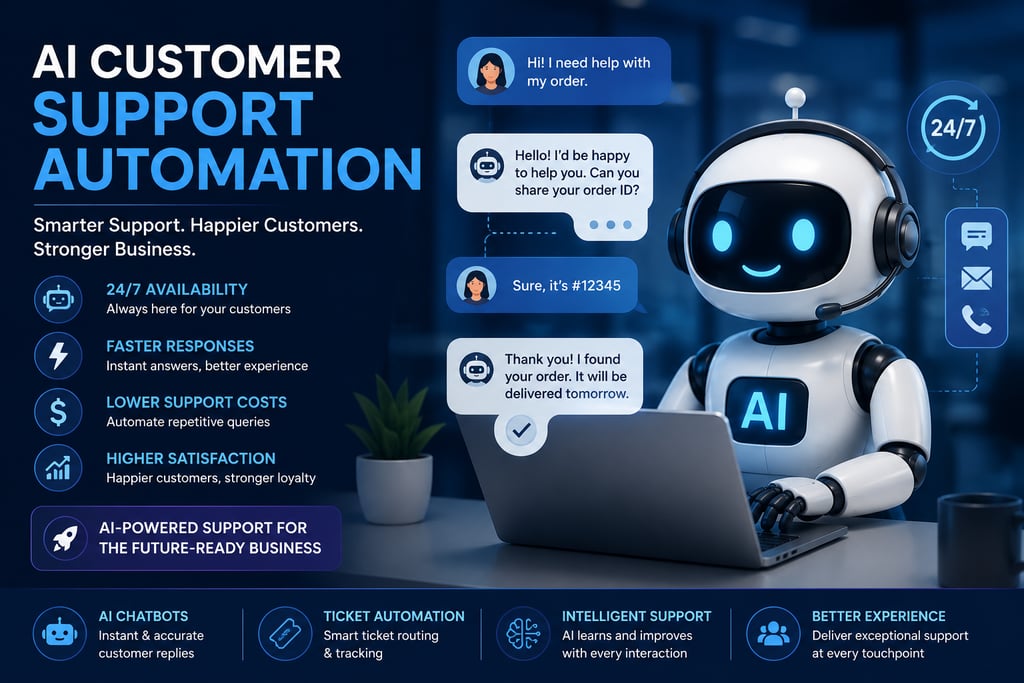
As the landscape of customer support evolves, AI chatbots and automation tools are becoming integral to enhancing customer experience. AI chatbots serve as the first point of contact in many customer service interactions. These intelligent systems utilize natural language processing to understand and respond to customer inquiries swiftly and efficiently. By addressing common questions and issues in real time, chatbots can significantly reduce wait times, allowing customers to receive immediate assistance. This not only improves customer satisfaction but also frees human agents to tackle more complex inquiries that require a personal touch.
In addition to chatbots, ticket automation systems play a crucial role in streamlining the management of customer queries. These systems are designed to automatically categorize, prioritize, and route tickets to the appropriate support personnel. By automating the ticketing process, organizations can ensure that requests are handled in a timely manner, thus minimizing response times and enhancing overall efficiency. Customers benefit from the structured support system, which ensures their inquiries are addressed according to urgency and type.
Moreover, smart customer service systems are revolutionizing the way businesses interact with their clients by leveraging machine learning and data analytics. These systems analyze vast amounts of customer interaction data to identify patterns and trends, enabling them to adapt their responses and recommendations based on past experiences. By doing so, they can provide personalized support tailored to individual customer preferences, fostering a more engaging and relevant interaction. As these technologies continue to advance, they promise to enhance the quality of customer service by delivering more authentic and meaningful interactions.
Real-World Applications: Success Stories in Business
In recent years, numerous businesses have embraced AI customer support automation, resulting in substantial improvements in customer experience and operational efficiency. For example, a leading e-commerce company succeeded in enhancing its customer service by integrating a sophisticated AI chatbot. This chatbot was capable of handling a multitude of customer queries simultaneously, which significantly reduced wait times and improved response accuracy. As a result, customer satisfaction ratings surged by over 30% within just three months of implementation.
Another compelling case study comes from a prominent telecommunications provider that utilized AI-powered virtual agents. These agents were designed to assist customers with common technical issues, billing inquiries, and service upgrades. The implementation of such technology not only streamlined the troubleshooting process but also freed up human agents to focus on more complex problems. This dual approach led to a 40% decrease in average handling time and a 25% reduction in operational costs, illustrating how AI customer support automation can promote business efficiency alongside enhanced service quality.
Additionally, a global travel agency adopted an AI-driven customer service platform to manage booking-related inquiries. Utilizing machine learning algorithms, the system was able to predict customer needs and provide proactive assistance, such as offering travel tips or notifying customers of flight changes. Following the switch, the agency reported a remarkable uptick in bookings and a noticeable improvement in customer loyalty. The success stories showcased here demonstrate that effective implementation of AI technologies can lead to substantial gains in customer satisfaction, operational efficiency, and overall business success.
Comparative Analysis: Traditional Customer Support vs. AI Customer Support Automation
In the quest to enhance customer experience, businesses often evaluate their support methodologies. A comparative analysis between traditional customer support and AI customer support automation reveals stark differences that can significantly influence customer satisfaction and operational efficiency.
Traditional customer support typically relies on human representatives to respond to queries. This approach can lead to varying levels of service quality, as it heavily depends on the individual capacities and knowledge of each agent. Furthermore, during peak hours, human agents may struggle to manage the volume of inquiries efficiently, resulting in longer wait times and potential dissatisfaction among customers.
In contrast, AI customer support automation leverages advanced technologies to streamline interactions. Chatbots and virtual assistants are capable of handling numerous inquiries simultaneously and provide immediate responses regardless of the time of day. This efficiency not only reduces wait times but also ensures that customers receive consistent information across all interactions.
Another significant benefit of AI automation is its ability to learn from past interactions. Machine learning algorithms analyze customer feedback and behaviors, enabling the systems to improve and adapt responses over time. This continuous learning process positions AI customer support to offer increasingly personalized experiences, whereas traditional methods often lack such responsiveness.
Moreover, cost-effectiveness is a crucial factor in this discussion. Implementing AI solutions can lower operational costs by reducing the need for extensive staffing while maintaining high levels of service availability. In comparison, traditional support may incur higher expenses due to personnel, training, and ongoing management costs.
Ultimately, while traditional methods still hold value in certain contexts, the advantages offered by AI customer support automation – including efficiency, personalization, and cost-effectiveness – are compelling reasons for businesses to consider transitioning towards more automated solutions.
Empowering Small Businesses with AI Support Automation
Small businesses often face immense challenges when competing with larger enterprises, particularly in delivering superior customer service. However, the advent of AI customer support automation has created a level playing field. By strategically implementing AI technologies, small businesses can enhance their customer service experiences and foster customer loyalty.
One effective strategy for small businesses is to adopt AI chatbots. These sophisticated tools can handle a multitude of customer inquiries round-the-clock, ensuring that customers receive timely responses at any hour. This capacity for instant support not only alleviates pressure on human support agents but also meets the growing expectation for immediate communication among consumers.
Additionally, integrating AI tools that analyze customer interactions can provide valuable insights into customer preferences and behavior. These analytics allow small businesses to tailor their support strategies, ultimately creating personalized experiences for their customers. By understanding their audience better, small enterprises can offer targeted promotions and relevant information, enhancing customer engagement.
Another benefit of AI customer support automation is scalability. As small businesses grow, the demand for customer support tends to increase. AI solutions can easily scale to accommodate higher volumes of inquiries without the need for significant investment in additional personnel. This adaptability ensures that businesses can maintain high service levels even during peak times.
Moreover, leveraging AI customer support automation can lead to cost savings. By reducing the time and resources spent on managing routine inquiries, small businesses can redirect these resources towards initiatives that drive growth, such as product development or marketing strategies.
In conclusion, small businesses have much to gain by embracing AI customer support automation. By utilizing these technologies, they can significantly improve their customer service experiences, compete more effectively against larger rivals, and ultimately foster stronger relationships with their customers.
Future Trends: AI Agents and Intelligent Customer Experiences
The evolution of artificial intelligence (AI) in customer support is poised to transform the way businesses interact with their customers. As we look towards 2026, several trends indicate the growing sophistication of AI agents and their roles in enhancing customer experiences. One notable trend is the increasing integration of machine learning algorithms, which enhance AI capabilities by allowing these systems to learn from past interactions and improve responses over time.
A key aspect of these developments is the shift towards more personalized customer experiences. AI agents equipped with advanced analytics can provide tailored recommendations and solutions based on individual customer preferences and behaviors. This personalization not only fosters a more engaging interaction but also increases customer satisfaction, loyalty, and retention. Moreover, as businesses collect and analyze larger volumes of customer data, the ability of AI to predict customer needs and adapt responses in real-time becomes even more critical.
Additionally, the push towards AI-driven omnichannel support is expected to gain momentum. Customers today expect seamless interactions across various platforms, including social media, email, and chat. Future AI agents will likely be developed with the capability to maintain context across different channels, ensuring a coherent and consistent experience for the customer, regardless of the medium used. This integration not only enhances the customer journey but also reduces the time and effort needed by businesses to manage multiple support avenues.
Furthermore, as technology advances, AI agents may begin to leverage natural language processing (NLP) to understand and respond to customer inquiries in a more human-like manner effectively. This improvement in conversation quality will make interactions more relatable and satisfying for customers, bridging the gap between technology and human interaction.
In conclusion, the future of customer support is increasingly being defined by the capabilities of AI agents. Businesses that strategically adopt these technologies and prepare for upcoming changes will likely maintain a competitive edge, providing intelligent customer experiences that meet evolving consumer expectations.
More Links
AI Customer Support Automation Page
Contact
Reach out to neuva ai for tailored AI solutions.
Phone
Connect@neuvaai.com
+91 9759115656
© 2026. All rights reserved @NeuvaAi.
Neuva AI provides AI-powered tools for education, business productivity and workplace automation.