AI Marketing Automation: The Future of Business Growth in 2026
AI Marketing Automation is transforming how businesses attract, engage and convert customers. From automated email campaigns and lead nurturing to customer segmentation and personalized marketing, AI helps organizations improve efficiency and maximize marketing results. Learn why AI Marketing Automation is becoming essential for business growth in 2026.
BUSINESS AUTOMATION
What is AI Marketing Automation?
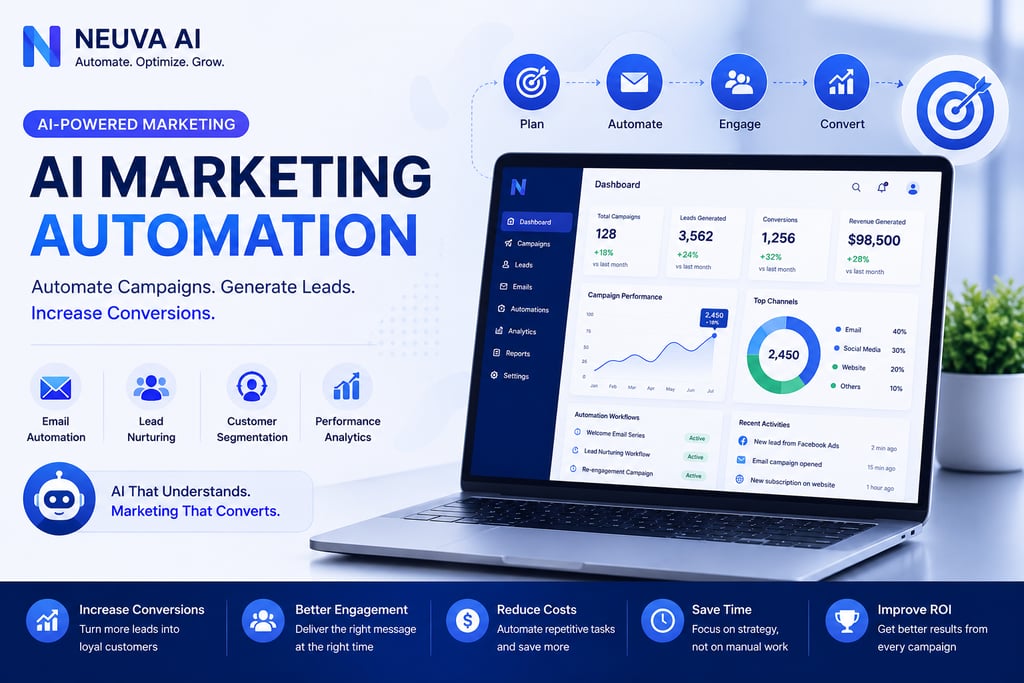
AI marketing automation refers to the integration of artificial intelligence technologies into the marketing automation process, enabling businesses to optimize their marketing strategies and improve customer engagement. At its core, AI marketing automation combines various components, including machine learning, data analysis, and predictive analytics, to facilitate more intelligent marketing functions. Unlike traditional marketing practices, which often rely on manual processes and generic targeting strategies, AI marketing automation leverages large datasets to tailor marketing efforts to individual consumer behaviors and preferences.
The fundamental technology behind AI in marketing begins with machine learning algorithms that analyze historical data to identify patterns and trends in consumer behavior. This analysis allows marketers to predict future buying habits and preferences, enabling them to design more effective campaigns. Data analysis is another critical component, as it helps businesses gather insights from various sources of customer interactions, such as website visits, social media engagement, and email responses. By utilizing this data, companies can refine their marketing strategies to be more aligned with their audience’s needs.
Moreover, predictive analytics plays a significant role by estimating the future outcomes of marketing initiatives based on historical data. This foresight allows businesses to allocate their resources efficiently and optimize their campaigns for better reach and conversion rates. By harnessing AI tools, organizations can streamline marketing processes, automating repetitive tasks such as email delivery, social media posting, and ad targeting. This not only improves operational efficiency but also enhances the overall effectiveness of marketing campaigns, resulting in increased ROI.
The Decline of Traditional Marketing Effectiveness
In recent years, traditional marketing methods have faced significant challenges, leading to a decline in their overall effectiveness. A primary issue is the changing behavior of consumers, who increasingly prefer digital interactions over conventional media. This shift is evidenced by the growing time spent on smartphones and social media platforms, a trend that traditional marketing struggles to accommodate.
Moreover, the saturation of traditional media channels has further diminished their impact. Consumers are bombarded with advertisements across various platforms, making them less receptive to standard marketing strategies such as print ads, TV commercials, and radio spots. This oversaturation leads to ad fatigue, where potential customers become desensitized to traditional messages, ultimately resulting in lower engagement rates and reduced return on investment for businesses relying on these methods.
Additionally, the rise of digital platforms presents considerable challenges for traditional marketing. Digital marketing allows for more precise targeting and personalization, using data analytics to reach specific demographics with tailored messages. In contrast, traditional marketing often lacks this level of granularity, resulting in broad, generic campaigns that may not resonate with the intended audience. The ability to track and measure performance in real-time also sets digital marketing apart, giving businesses actionable insights to refine their strategies promptly.
As consumers continue to gravitate towards digital experiences, the limitations of traditional marketing are becoming increasingly apparent. The need for businesses to adapt and consider alternatives that leverage technology is critical. Thus, the urgency for adopting AI marketing automation solutions emerges as a viable avenue for enhancing marketing effectiveness, addressing the gaps left by traditional approaches, and responding to the dynamic landscape of modern consumer behavior.
Enhancing Marketing Campaigns through AI
In the rapidly evolving landscape of digital marketing, artificial intelligence (AI) plays a pivotal role in enhancing the effectiveness of marketing campaigns. By leveraging predictive analytics, businesses can forecast consumer behavior and identify trends, allowing for more targeted marketing efforts. This capability enables companies to anticipate customer needs and tailor their marketing strategies accordingly, resulting in increased conversion rates and customer satisfaction.
Automated content generation is another significant way AI enhances marketing campaigns. Through Natural Language Processing (NLP) and machine learning algorithms, AI can create personalized and relevant content, which resonates with the target audience. This not only saves time for marketers but also ensures that the content remains fresh and engaging. The ability to produce tailored messages at scale means that brands can communicate with their audience in a way that feels personal, leading to improved customer relationships.
Moreover, AI facilitates performance optimization by continuously analyzing campaign data and providing insights that help marketers refine their strategies. Through real-time data analytics, businesses can evaluate what is working and what is not, enabling quick adjustments that enhance campaign performance. With AI's capabilities, marketers can also segment audiences more effectively, ensuring that each group receives content that is aligned with their specific interests and behaviors.
AI-driven marketing not only personalizes user experiences but also creates a cyclical feedback loop that informs future marketing efforts. As the AI systems learn from ongoing interactions and consumer responses, they become increasingly adept at predicting outcomes and optimizing campaigns to align with consumer expectations. By embracing these advanced techniques, marketers can enhance the overall efficiency of their campaigns, drive engagement, and foster long-term brand loyalty.
Key Applications of AI Marketing Automation
AI marketing automation encompasses various applications that significantly enhance marketing strategies and drive business growth. One of the primary applications is in email marketing automation, where AI technologies streamline the creation, distribution, and targeting of email campaigns. By utilizing machine learning algorithms, businesses can analyze customer behavior and preferences, ensuring that emails are personalized and sent at optimal times to maximize engagement.
Another critical aspect of AI marketing automation is lead nurturing. AI systems can automate communication with potential customers, providing relevant information and support throughout the buyer's journey. This automated approach not only helps maintain engagement but also increases the likelihood of converting leads into paying customers.
Customer segmentation is also revolutionized through AI capabilities. By analyzing data, AI can identify patterns and segment audiences based on demographics, behavior, and interests. This segmentation allows marketers to tailor their strategies and content precisely to meet the needs of different customer groups.
Furthermore, personalized marketing has become more sophisticated with AI. Technologies can analyze individual customer data to offer personalized content, recommendations, and offers that resonate with specific users, enhancing the overall customer experience and driving higher conversion rates.
Social media is another domain where AI plays a pivotal role. Social media automation tools powered by AI can schedule posts, respond to comments, and analyze engagement metrics, enabling marketers to maintain a consistent presence without sacrificing valuable time.
Lastly, marketing analytics leverages AI to conduct advanced data analysis. By utilizing AI-driven insights, businesses can make informed decisions about their marketing strategies, optimizing campaigns based on performance data and ultimately improving ROI.
Benefits of AI Marketing Automation
AI marketing automation has emerged as a transformative solution for businesses looking to streamline their marketing operations and enhance overall effectiveness. One of the foremost benefits is the capacity to increase conversions. By utilizing AI algorithms to analyze consumer behavior patterns, businesses can send highly targeted and personalized messages to potential customers, resulting in higher engagement rates. For instance, a study conducted by HubSpot revealed that companies leveraging AI for targeted marketing witnessed an increase in conversion rates by as much as 30%.
Another notable advantage of AI marketing automation is enhanced customer engagement. Automation tools can segment audiences based on their preferences and behaviors, allowing businesses to deliver content that resonates with them directly. For example, a retail brand using AI-driven automation could send personalized recommendations during certain shopping seasons, thus deepening the relationship with customers and promoting loyalty.
AI marketing automation also contributes to significant cost reductions. By automating repetitive tasks such as email marketing, social media posting, and customer segmentation, businesses can reallocate their resources to more strategic initiatives. Research by McKinsey & Company suggests that companies employing automation tactics can reduce overhead marketing costs by 20% to 30% over time.
Time savings is yet another crucial benefit of integrating AI into marketing practices. Automated systems can execute tasks within minutes that would typically take hours or even days. For instance, automating lead scoring not only saves time but also improves accuracy, allowing teams to focus on high-quality leads that are more likely to convert.
Finally, the enhanced return on investment (ROI) is paramount. With more efficient campaigns and better-targeted communications, businesses can expect an improved ROI. Data from Salesforce has shown that businesses using AI in their marketing strategies can see an increase in marketing ROI by at least 10 to 20% compared to those that do not utilize these tools. In light of these benefits, AI marketing automation stands as a vital component of a forward-thinking business strategy.
Real-World Business Use Cases
As businesses increasingly turn to AI marketing automation to enhance their operational efficiencies, several noteworthy case studies illustrate the successful implementation of these cutting-edge technologies across various sectors. One compelling example is found in the retail industry, where a leading e-commerce platform adopted AI-driven marketing automation tools to personalize customer experiences. By analyzing shopping patterns and preferences, the platform deployed targeted email campaigns and product recommendations, leading to a 30% increase in conversion rates. Additionally, the automation effectively reduced the workload on marketing teams, allowing them to focus on strategic initiatives.
Another remarkable instance can be seen in the travel sector, where an airline utilized AI marketing automation to streamline its customer engagement process. Through the collection and analysis of traveler data, the airline was able to send personalized offers based on past travel behaviors and preferences. This strategic move not only improved customer satisfaction but also directly contributed to a 25% rise in ancillary revenue from upsells and cross-sells. However, the airline faced challenges such as ensuring data privacy and managing the evolving customer expectations in a highly competitive market.
The healthcare industry also presents a noteworthy use case. A hospital network incorporated AI marketing automation to improve patient interactions and treatment follow-ups. By automating appointment reminders and post-visit surveys, the network enhanced its patient's engagement and care continuity. Consequently, the hospital reported a 40% reduction in missed appointments, facilitating better resource management and improving patient outcomes. While there were obstacles in integration with existing systems, the measurable benefits of enhanced patient communication underscored the value of AI-driven marketing solutions.
These real-world examples illustrate not just the versatility of AI marketing automation across various industries, but also the tangible outcomes achievable through its implementation. By leveraging data analytics and personalized marketing strategies, businesses can boost engagement and optimize their marketing efforts significantly.
Comparing Traditional Marketing and AI Marketing Automation
As businesses navigate the evolving landscape of marketing, understanding the distinctions between traditional marketing methods and AI marketing automation becomes crucial. The contrast is stark across several critical dimensions, including cost, efficiency, targeting accuracy, data utilization, and customer interaction.
Cost: Traditional marketing typically involves higher upfront expenditures, including print advertisements, TV commercials, and extensive promotional campaigns. In comparison, AI marketing automation reduces overall costs by streamlining processes and enhancing resource allocation. For instance, automated email campaigns and digital ads can achieve similar outreach at a fraction of the cost.
Efficiency: Traditional marketing strategies often require significant time to plan and execute, with multiple iterations needed before achieving desired results. Contrastingly, AI marketing automation allows for rapid campaign deployment and quick adjustments based on real-time analytics. This ensures that businesses can react swiftly to market changes, maximizing their impact.
Targeting Accuracy: Traditional marketing methods rely on broad demographic information to reach potential customers. AI marketing automation leverages machine learning algorithms to analyze vast data sets and predict customer behavior. This capability allows businesses to target specific audience segments more precisely, increasing conversion rates and customer satisfaction.
Data Utilization: In the realm of traditional marketing, data collection can be fragmented and labor-intensive. AI marketing automation, however, integrates data management systems that provide actionable insights across various channels. This enables marketers to develop tailored strategies based on real-time consumer behavior and preferences.
Customer Interaction: While traditional marketing often employs one-way communication channels, AI marketing automation fosters two-way interactions. Through chatbots, personalized emails, and social media engagement, businesses enhance their ability to connect with customers in meaningful ways, thus improving brand loyalty.
In summary, the emergent benefits of AI marketing automation signify a transformative shift from traditional marketing practices. Leveraging advanced technologies allows businesses to streamline operations, reduce costs, and ultimately drive growth in an increasingly competitive marketplace.
Future Trends in AI-Powered Marketing
As we look forward to the future of business growth in 2026, AI-powered marketing is poised to undergo significant transformations. Advanced analytics will emerge as a cornerstone of marketing strategies, enabling businesses to gather and interpret vast amounts of data in near real-time. This capability will allow organizations to make data-driven decisions that not only enhance operational efficiency but also greatly improve their understanding of consumer behavior.
Additionally, the trend of deeper personalization is likely to escalate. In 2026, consumers will expect brands to deliver tailored experiences that reflect their individual preferences and past interactions. AI algorithms will play a crucial role in creating these personalized journeys, efficiently segmenting audiences and predicting future behaviors. By harnessing machine learning, marketers will be able to craft engaging content that resonates specifically with targeted demographics, thus increasing conversion rates.
Another trend influencing AI-driven marketing will be the growing emphasis on customer experience. Businesses will shift their focus from merely acquiring customers to enhancing their overall journey with the brand. AI can facilitate this by analyzing customer feedback, interacting via chatbots, and optimizing various touchpoints along the customer journey. Companies that prioritize customer experience will not only foster loyalty but will also differentiate themselves in increasingly competitive markets.
However, while the benefits of AI in marketing are numerous, potential challenges should not be overlooked. Concerns regarding data privacy and ethical usage of AI technologies will necessitate careful consideration. Companies must navigate regulations and ensure transparency in their AI practices to maintain consumer trust. Furthermore, aligning AI advancements with organizational culture will be essential for seamless integration.
By proactively addressing these challenges, businesses can leverage AI marketing automation to achieve sustainable growth and position themselves as industry leaders in this evolving landscape.
Frequently Asked Questions
AI marketing automation has gained significant traction over the last few years, leading to numerous inquiries from businesses aiming to adopt this technology. Below are some of the most frequently asked questions regarding AI marketing automation.
1. What are the key challenges in implementing AI marketing automation?
Implementing AI marketing automation can pose several challenges. These may include a lack of technical expertise within the team, the necessity for quality data to train AI models, and the need to integrate the automation tools with existing marketing systems. Additionally, change management plays a critical role, as businesses often need to adjust their workflows and strategies to effectively utilize AI.
2. What kind of ROI can be expected from AI marketing automation?
The return on investment (ROI) from AI marketing automation can be substantial, as it often leads to improved customer engagement, increased productivity, and enhanced data-driven decision-making. While exact ROI figures vary based on industry and implementation scale, businesses often report noticeable improvements in lead generation and conversion rates, which collectively enhance profitability over time.
3. How does AI marketing automation differ across various industries?
AI marketing automation is not a one-size-fits-all solution. Different industries leverage automation in varied ways due to their unique needs and challenges. For instance, the retail sector may focus on personalized customer experiences, while the finance industry may prioritize compliance and data analysis. Understanding specific industry requirements is crucial for successful implementation.
4. Is it necessary to have a robust data strategy before adopting AI marketing automation?
Yes, having a solid data strategy is paramount for the success of AI marketing automation. Effective AI models rely on high-quality data for training and accuracy. Businesses should ensure they have a strategy in place to collect, store, and analyze their data efficiently, which will ultimately enhance the performance of their automation efforts.
5. What future trends can we expect in AI marketing automation?
The future of AI marketing automation is promising, with trends indicating greater personalization, advanced predictive analytics, and improved integration with different marketing channels. As AI technology continues to evolve, businesses can expect enhanced capabilities, such as real-time data analysis and the ability to respond proactively to consumer behavior, further driving efficiency and growth.
Conclusion and Call to Action
As we look ahead to 2026, the role of AI marketing automation in driving business growth is increasingly clear. The integration of artificial intelligence into marketing strategies offers a multitude of benefits, from enhanced efficiency to improved customer engagement. AI marketing automation streamlines processes that traditionally required extensive human resources, allowing companies to allocate their personnel towards more strategic initiatives. This pivot not only reduces operational costs but also enhances the ability to generate personalized marketing campaigns that resonate with consumers on an individual level.
Furthermore, the data analytics capabilities of AI enable businesses to gain deeper insights into consumer behavior and market trends. By leveraging these insights, organizations can make informed decisions that pave the way for innovation and expansion. Automation not only facilitates real-time interactions with customers but also enhances forecasting abilities, enabling businesses to stay ahead of their competitors. Given these advantages, the incorporation of AI into marketing strategies is not just an option but a necessity for sustainable growth.
In light of these compelling arguments, it is imperative for businesses to consider the timely integration of AI into their marketing frameworks. The transformation that AI marketing automation brings can significantly impact customer satisfaction and overall business performance. To navigate this landscape effectively, organizations need a reliable partner adept in AI solutions.
Neuva AI stands out as a leading provider of AI business automation, ready to assist organizations in harnessing the full potential of AI marketing. By collaborating with Neuva AI, businesses can adopt innovative technologies that align with their marketing goals and drive growth. The future of marketing is here, and the time to act is now; embrace AI to transform your marketing strategy.
Internal Links
AI Customer Support Automation
AI CRM Automation
Business Automation Solutions
Contact
Reach out to neuva ai for tailored AI solutions.
Phone
Connect@neuvaai.com
+91 9759115656
© 2026. All rights reserved @NeuvaAi.
Neuva AI provides AI-powered tools for education, business productivity and workplace automation.