How AI Question Paper Generators Help Teachers Create Better Assessments in 2026
AI Question Paper Generators are transforming assessment design for teachers and schools. These tools help educators create balanced question papers, align assessments with learning outcomes and reduce the time spent on manual paper preparation. Learn how AI-powered question paper generation improves efficiency, accuracy and academic quality in 2026.
AI IN EDUCATION
Understanding AI Question Paper Generators
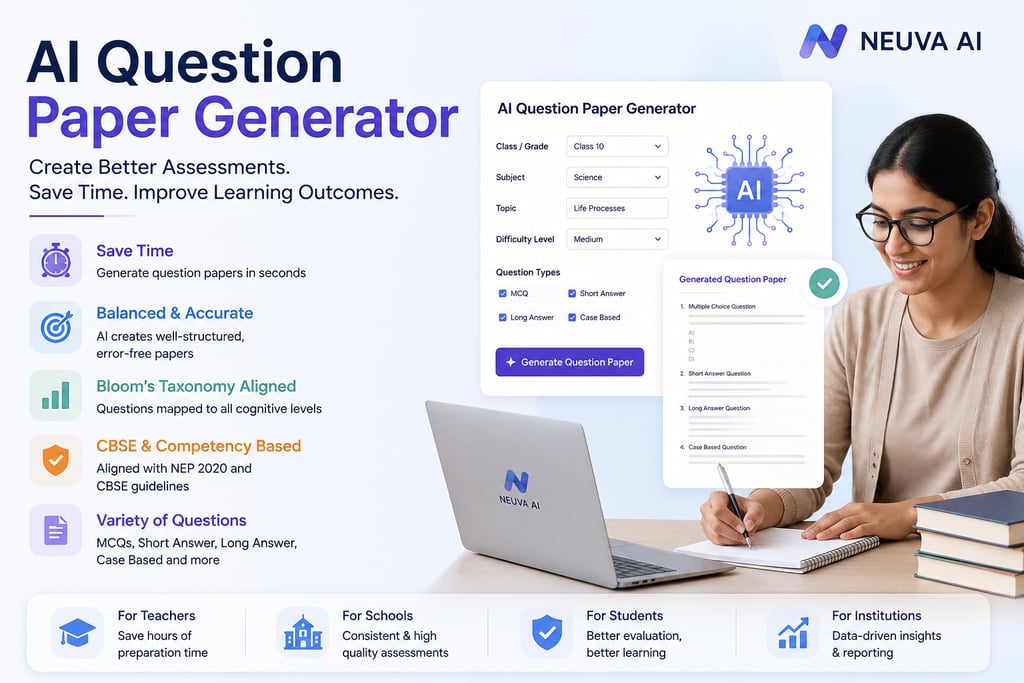
AI question paper generators represent an innovative application of artificial intelligence in the educational sector. The primary purpose of these tools is to automate the creation of assessment papers, thereby streamlining a process that can often be time-consuming and labor-intensive for educators. By integrating advanced algorithms, these generators are capable of producing varied and comprehensive question sets tailored to specific subjects or topics.
One of the key functionalities of AI-driven question paper generators is their ability to analyze vast amounts of data. This enables the tools to generate questions that not only align with curriculum standards but also reflect the cognitive levels required by educators. Additionally, these generators often incorporate features such as difficulty ranking, variety of question types (multiple choice, essay, true/false, etc.), and customizable formats to fit the needs of individual teachers or institutions.
Modern AI question paper generators also support adaptive learning by allowing educators to generate assessments that cater to diverse learning styles and abilities. This adaptability is crucial, particularly in environments with varying student competencies, as it ensures all learners are equally assessed based on their understanding of the material. Furthermore, since these tools often use machine learning, they can continuously refine their output by learning from previous assessments, thereby improving the quality and relevance of the generated questions.
In the context of modern education, the relevance of AI question paper generators cannot be overstated. They assist educators in effective time management, allowing them to focus more on teaching rather than administrative tasks. By leveraging technology, these tools enhance the ability to create focused assessments that effectively gauge student comprehension and learning outcomes. Overall, AI question paper generators signify a significant advancement in educational technology, aligning assessment practices with contemporary educational needs.
Challenges of Manual Question Paper Preparation
Manual question paper preparation is characterized by numerous challenges that not only increase workload but also compromise the quality of assessments. One of the most significant drawbacks is the time consumption associated with crafting questions. Teachers often find themselves spending countless hours designing question papers that adhere to curriculum standards while attempting to ensure a diverse range of question types. This can detract from valuable instructional time and impede the overall educational process.
Another issue is the prevalence of human error in manual preparation. Errors in question phrasing, incorrect answers, or misalignment with learning objectives can easily occur, leading to misleading assessments. Such inaccuracies can undermine the effectiveness of evaluations, skewing results that inform both teaching strategies and student understanding. Moreover, a lack of systematic approaches to ensure quality poses another obstacle, as educators may inadvertently replicate questions from previous exams, resulting in a limited range of assessment styles.
Additionally, ensuring a diverse array of question types is often challenging when relying solely on manual preparation. Traditional assessment formats may prioritize certain question types, such as multiple-choice or true/false questions, thereby neglecting alternative forms like short answers or project-based queries. This lack of diversity can hinder a comprehensive assessment of student learning, as different formats can capture varying levels of understanding and skills.
Furthermore, alignment with learning outcomes is critical for any assessment. Teachers may struggle to ensure that their manually prepared questions adequately reflect the objectives specified in the curriculum. Misalignment can lead to inadequate assessments that fail to measure students' true capabilities or readiness for subsequent academic challenges.
Advantages of AI in Assessment Creation
In the current educational landscape, artificial intelligence (AI) question paper generators present numerous advantages that significantly enhance the assessment creation process for teachers. One of the primary benefits is the substantial time saved during the preparation of examination materials. Traditional methods often involve intensive manual labor to develop questions that are varied and comprehensive. In contrast, AI systems can quickly produce a range of questions tailored to specific topics, therefore allowing educators to allocate more time towards instructional activities.
Another critical advantage lies in the generator's ability to create balanced assessments. Effective assessments must encompass all relevant topics to ensure that students have a comprehensive understanding of the material. AI question paper generators analyze the curriculum requirements and generate assessments that reflect an equitable distribution of topics. This feature not only aids teachers in creating fair evaluations but also ensures that students are assessed on their overall knowledge rather than isolated areas.
Moreover, AI enables the creation of competency-based questions designed to measure specific skills among students. By integrating nuanced understanding of Bloom's taxonomy, these systems align questions with higher-order cognitive levels, encouraging critical thinking and problem-solving abilities. This shift towards competency-based assessments ensures that students are evaluated not only on their memorization skills but also on their ability to apply knowledge effectively in practical scenarios.
Additionally, the overall quality of assessments is fundamentally improved through the use of AI. Automated systems can implement advanced algorithms to review and refine question quality, ensuring clarity, relevance, and appropriateness of the language used in assessments. Therefore, teachers are empowered to focus on crafting engaging curriculum content, while AI manages the intricacies associated with assessment design, resulting in a more effective learning experience for students.
Benefits for Schools and Examination Departments
The integration of AI question paper generators into the educational landscape provides substantial advantages for schools and examination departments. One of the primary benefits lies in the enhancement of administrative efficiency. Traditional methods of question formulation often involve significant time and resource investment, leading to potential delays in assessment preparation. AI question paper generators alleviate these concerns by automating the creation process, allowing for quicker turnaround times. This increased efficiency enables educators to focus on more critical pedagogical duties, thus streamlining operations within educational institutions.
Furthermore, the utilization of these advanced tools promotes better tracking of assessment standards. AI systems can analyze historical assessment data, identify trends, and ensure that new question papers adhere to established educational criteria. This results in a more standardized approach to testing, ultimately leading to improved consistency across various assessments. With AI-generated question papers, examination departments can effortlessly monitor alignment with curriculum standards, ensuring that every student is assessed fairly and comprehensively.
Another significant benefit pertains to the overall improvement in student performance due to the quality of the assessments generated. By relying on AI, schools can craft questions that are not only aligned with curriculum goals but also cater to a diverse learning spectrum. Higher-quality questions can challenge students appropriately and help identify individual strengths and weaknesses effectively. Consequently, this adaptive approach to assessment fosters enhanced learning outcomes and significantly assists educators in tailoring instructional strategies.
Finally, the implications of these advancements extend into policy-making and resource allocation within educational institutions. Data-driven insights gleaned from AI-generated assessments can inform strategic decisions regarding curriculum development and resource deployment, ensuring that schools allocate funding and resources where they’ll have the most significant impact on student learning.
AI-Generated Assessment Workflow Examples
The integration of AI question paper generators into educational settings has revolutionized the way assessments are created, allowing teachers to streamline their workflows and enhance educational outcomes. Below are four specific examples illustrating different assessment workflows that leverage these advanced tools.
In the first scenario, a mathematics teacher prepares for an upcoming examination. The teacher inputs key parameters, such as the grade level, types of questions desired (multiple-choice, true/false, or short answer), and specific topics to cover. The AI system analyzes the requirements and generates a comprehensive question set that is tailored to the curriculum. Within minutes, the teacher has a ready-to-use assessment that meets all specified criteria.
Another example involves a language arts instructor preparing a reading comprehension test. By providing the AI generator with a set of literary works and desired learning outcomes, the teacher receives diverse question formats—ranging from factual recall to interpretive reasoning—ensuring a well-rounded assessment. This not only saves time but also enhances the quality of evaluation through the inclusion of varied cognitive levels.
A science teacher also benefits from an AI question paper generator when designing practical assessments. After indicating the laboratory activities covered in class, as well as the skills to be assessed, the AI develops questions that challenge students to apply their knowledge in practical contexts. It ensures higher-order thinking processes are assessed, which are critical in science education.
Lastly, consider a social studies teacher who aims to create a summative assessment spanning multiple units. By inputting the overarching themes and essential questions, the AI tool creates a cohesive assessment that reflects students’ understanding of the interconnectedness of historical events. This tailored workflow exemplifies how AI can facilitate the creation of assessments that are not only efficient but also aligned with pedagogical goals.
Manual vs. AI Question Paper Creation: A Comparison
Creating effective assessments is a crucial task for educators, and the methods of generating question papers can significantly impact their effectiveness. When comparing manual question paper creation to AI question paper generators, several key factors emerge that highlight the strengths and weaknesses of each approach.
Firstly, the time required for question paper creation varies greatly between these methods. Manual creation can be a time-consuming process, often taking several hours to days as educators must formulate questions, research relevant content, and ensure alignment with learning outcomes. In contrast, AI question paper generators can produce a comprehensive set of questions in a matter of minutes, allowing teachers to focus on other critical aspects of their teaching.
Secondly, accessibility to a diverse range of questions is another comparative factor. Manual question creation is limited to the educator's knowledge and experience, often resulting in repetitive or predictable questions. AI question paper generators, however, access vast databases of questions across various topics and difficulty levels, ensuring a rich and diverse question set that can cater to different learning styles and objectives.
Moreover, error rates can play a significant role in determining effectiveness. Manual processes are prone to human error, which can lead to ambiguities or inaccuracies in assessments that may confuse students. Conversely, AI systems are designed to enhance accuracy through algorithms that minimize mistakes, although they too are not entirely infallible.
Lastly, when considering the overall effectiveness of assessments produced, AI question paper generators stand out for their ability to adapt to changing educational standards and requirements. They can quickly incorporate feedback from past assessments, ultimately leading to improved student performance. In contrast, traditional manual methods might lack this adaptability, as revisions are often slow to implement.
CBSE Relevance and Competency-Based Assessment
The Central Board of Secondary Education (CBSE) in India has been a pivotal force in shaping the educational framework, focusing not only on knowledge acquisition but also on enhancing learners' competencies. In recent years, there has been a pronounced shift towards competency-based assessment, aimed at evaluating students' application of knowledge in real-world scenarios rather than mere rote learning. This paradigm emphasizes the necessity for assessments that are aligned with the learning objectives defined by the CBSE curriculum.
AI question paper generators play a significant role in this transition. By utilizing algorithms and machine learning, these tools can craft assessments that are tailored to evaluate specific competencies outlined by the CBSE. This ensures that the questions are not only pertinent but also in sync with the educational standards set forth by the curriculum. The ability of these AI systems to analyze vast amounts of data allows them to generate diverse question formats, ranging from multiple-choice questions to more complex scenarios that require critical thinking and problem-solving skills.
Moreover, the integration of such technology aids teachers in efficiently designing assessments that are both fair and comprehensive. With minimal effort, educators can create papers that reflect various difficulty levels and cognitive skills, thereby catering to the differentiated learning needs of students. This alignment between assessments and competency-based education facilitates a more accurate measurement of student performance, ensuring that assessments are more than just a tool for grading, but rather a genuine reflection of students’ abilities and readiness for future challenges.
In conclusion, as education continues to adapt in the digital age, the role of AI question paper generators within the framework of CBSE remains crucial in fostering a competency-based assessment approach. By streamlining the creation of relevant assessments, these AI tools enhance the educational experience and prepare students more effectively for their academic and professional futures.
Frequently Asked Questions
As the use of AI question paper generators becomes increasingly prevalent in educational settings, it is natural for teachers and administrators to have questions regarding their functionality, effectiveness, and the overall impact on teaching and learning. Here we address some of the most common queries surrounding this innovative technology.
1. How do AI question paper generators work?
AI question paper generators use advanced algorithms and machine learning techniques to create customized assessments tailored to specific subjects and learning objectives. By analyzing vast databases of existing questions and academic standards, these tools can automatically formulate questions that are relevant and appropriately challenging for students.
2. Are AI-generated questions as effective as those created by teachers?
Research indicates that AI-generated questions can often match the quality of traditionally constructed assessments. However, the effectiveness greatly depends on the sophistication of the AI system and how well it aligns with curricular goals. Many educators find that using these generators enhances their existing question banks, providing diverse and varied assessment options.
3. Can teachers customize the questions generated?
Yes, most AI question paper generators allow for substantial customization options. Teachers can specify topics, question types (such as multiple choice, true/false, or essay), and difficulty levels, enabling them to tailor assessments to their class's unique needs and learning objectives.
4. How do these tools impact student learning outcomes?
AI-generated assessments can lead to improved student engagement by offering timely, varied, and differently framed questions, potentially leading to better understanding and retention of material. By reducing the time teachers spend on exam creation, they can focus more on instructional practices that directly enhance learning.
5. What are the potential downsides of using AI in assessment creation?
While AI question paper generators offer numerous advantages, there are some concerns to consider. These may include the risk of generating questions that lack depth or context, as well as potential over-reliance on technology, which can impact the personal touch that teachers typically provide in assessment design. It is essential for educators to balance the use of AI tools with their professional insights.
Spotlight on Neuva AI Question Paper Generator
The Neuva AI Question Paper Generator represents a noteworthy innovation in the realm of educational technology. Leveraging sophisticated algorithms and machine learning techniques, this tool has been designed to assist educators in developing high-quality assessments efficiently and effectively. One of the primary advantages of the Neuva system is its capacity to generate diverse types of questions, ranging from multiple choice to open-ended prompts, catering to a variety of pedagogical needs.
One of the standout features of the Neuva AI generator is its personalized learning context. By analyzing the specific curriculum and student performance data, the system creates assessments that are tailored to the learners' current skill levels. This customization not only enhances the relevance of the assessments but also promotes a more engaging learning experience for students. Furthermore, the AI can adapt in real-time to the evolving educational landscape, ensuring that the questions remain relevant and aligned with current educational standards.
Another significant benefit of utilizing the Neuva AI Question Paper Generator is the substantial reduction in time and effort required for teachers to create assessments. Automating the question generation process allows educators to focus on other critical aspects of teaching, such as providing personalized feedback and fostering student engagement. Moreover, the analytics features of Neuva can provide educators with insights into student performance, enabling them to identify knowledge gaps and adjust instruction accordingly. In essence, the Neuva AI Question Paper Generator exemplifies how technology can streamline the assessment process, thereby enhancing teaching effectiveness and improving learning outcomes.
Conclusion and Call to Action
In an age where educational methodologies are ceaselessly evolving, the integration of AI question paper generators into assessment strategies is becoming increasingly essential. These technological tools not only streamline the process of creating assessments but also enhance the quality of questions by adapting to learner needs, thereby addressing diverse educational backgrounds and varying levels of comprehension. As discussed, AI question paper generators facilitate the creation of tailored assessments that are reflective of individual learning trajectories.
Moreover, the ability of these tools to analyze data and generate questions based on the latest educational trends empowers educators to stay relevant in an ever-changing academic landscape. This ensures that assessments are not only relevant but also challenging, pushing students to engage with the material in a meaningful way. With capabilities such as auto-grading and immediate feedback, such technology significantly reduces the administrative burden on educators, allowing them to focus more on teaching rather than on test preparation.
As we transition further into 2026, it is crucial for educators and educational stakeholders to consider how AI question paper generators can be integrated into their teaching practices. This can lead to improved student outcomes and a more comprehensive understanding of subject matter. It is an opportunity not to be missed; by embracing this technology, educational institutions can foster an environment that promotes critical thinking, creativity, and collaboration among students.
We encourage educators to explore various AI tools and engage with professional development opportunities that focus on this technology. Implementing AI question paper generators could be a transformative step in enhancing assessment strategies and overall educational effectiveness.
Contact
Reach out to neuva ai for tailored AI solutions.
Phone
Connect@neuvaai.com
+91 9759115656
© 2026. All rights reserved @NeuvaAi.
Neuva AI provides AI-powered tools for education, business productivity and workplace automation.