The Future of Work in 2026: AI-Powered AI Automation vs. Human Expertise
Explore the future of AI automation and human expertise in 2026. Learn which tasks should be automated and how AI helps schools, offices, and businesses improve productivity.
AI & FUTURE TECHNOLOGY
What AI Automation Means
AI automation refers to the integration of artificial intelligence technologies to enhance or entirely manage tasks traditionally performed by humans. Unlike traditional automation, which typically relies on predefined rules and fixed processes, AI automation utilizes advanced algorithms and machine learning techniques to adapt and improve its performance over time. This represents a significant evolution in how tasks can be accomplished within various industries.
The core principles of AI automation revolve around the ability of machines to learn from data. Through machine learning, programs can identify patterns, make predictions, and even optimize their own functions without explicit programming for every outcome. This learning capability allows AI systems to manage increasingly complex tasks compared to their traditional counterparts, which lack such flexibility and adaptability.
A key component of AI automation is the role of algorithms, which serve as a set of instructions for processing data. These algorithms analyze vast amounts of information to generate insights or automate decision-making processes that were previously time-consuming and error-prone when performed by humans. By leveraging real-time data processing, AI systems can respond to changing environments and demands more efficiently than traditional automated systems.
Another critical aspect of AI automation is the utilization of big data. The abundance of data generated across various platforms provides a rich basis for training AI systems, enabling them to refine their functionalities and accuracy. In contrast, traditional automation systems might rely on static datasets, limiting their ability to evolve.
Overall, AI automation signifies a paradigm shift in how we approach work and productivity. As these technologies continue to advance, they are set to transform industries, driving efficiency and innovation while simultaneously posing new challenges and questions regarding the future role of human expertise.
Tasks Best Suited for AI
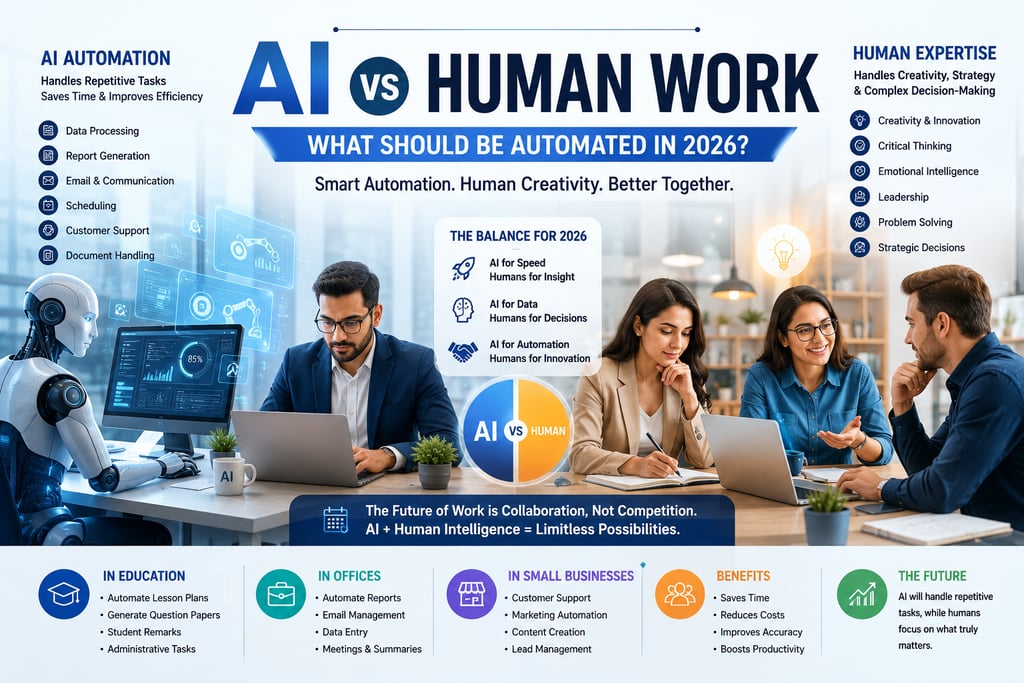
As we look towards the future of work in 2026, the integration of AI-powered automation plays a critical role in reshaping various tasks across different industries. There are several specific tasks that are particularly well-suited for automation through AI, given its strengths in efficiency and precision.
One prominent area where AI excels is in data entry. This repetitive task, often prone to human error, benefits enormously from automation. AI algorithms can process vast amounts of data with remarkable speed and accuracy, minimizing mistakes that can arise from manual entry. The ability of AI to learn from patterns also allows for continuous improvement, further enhancing productivity.
Scheduling is another task that can be effectively managed by AI systems. Automated scheduling tools utilize algorithms to optimize calendars by considering multiple variables such as participant availability, time zone differences, and meeting preferences. This not only saves time for human schedulers but also ensures a higher rate of efficiency in organizing meetings or events.
Inventory management is yet another domain where AI can significantly contribute. AI-powered systems can monitor stock levels in real-time, predict inventory needs based on historical data, and automatically reorder supplies when quantities fall below a predetermined threshold. This capability not only streamlines operations but also enhances decision-making processes by providing accurate data analytics at a moment’s notice.
Additionally, AI assists in handling customer interactions through chatbots. These automated systems can provide immediate responses to customer inquiries, reducing wait times and improving the overall customer service experience. By handling routine queries, AI allows human agents to focus on more complex issues that require a personal touch.
In conclusion, tasks such as data entry, scheduling, inventory management, and customer interaction are prime candidates for AI automation. The advantages of utilizing AI in these areas include time savings, increased accuracy, and a significant decrease in human error, paving the way for a more efficient working environment in the near future.
Tasks That Need Human Expertise
As we navigate through the landscape of work in 2026, it is evident that certain tasks remain firmly grounded in the realm of human expertise. While AI-powered automation continues to evolve and augment efficiencies, there are specific areas wherein the nuances of human judgment, creativity, and emotional intelligence are paramount. These irreplaceable attributes set humans apart in complex and dynamic work environments.
One significant domain requiring human insight is strategic planning. Effective leadership often hinges on the ability to assess multifaceted scenarios, consider various stakeholder perspectives, and craft long-term plans that adapt to changing conditions. This strategic foresight cannot be entirely distilled into algorithms, as it necessitates a deep understanding of human behavior, market trends, and the emotional climate within an organization.
Moreover, tasks that involve nuanced customer service also demand a level of human interaction that AI cannot replicate fully. Scenarios where customers express dissatisfaction or complex needs often require empathy, active listening, and tailored responses. Human agents can read body language, tone, and emotional cues that inform their engagement and response strategies, which are essential for maintaining customer loyalty and satisfaction.
In the creative realm, human expertise thrives in content creation, art, and design. While AI can generate text, music, or art, the deep well of human creativity drives the emotional resonance and cultural relevance behind such works. Creative professionals infuse their experiences, cultural contexts, and imaginative visions, producing content that resonates on a profound level with audiences.
In conclusion, despite advancements in AI technology, tasks requiring human expertise remain vital. Strategic planning, nuanced customer service, and creative endeavors underscore the irreplaceable value of human skills, reinforcing the need for a harmonious coexistence between automation and human intellect in the workplace of the future.
AI in Education
Artificial Intelligence (AI) is revolutionizing various sectors, with education being a significant area of impact. AI tools are increasingly being integrated into educational settings; these technologies enhance personalized learning experiences, which cater to the unique needs of each student. By utilizing data analytics, AI can assess individual learning patterns, thereby allowing educators to tailor curriculum content that aligns with students' strengths and weaknesses. This personalization can foster engagement and improve knowledge retention, crucial factors in effective teaching and learning.
Moreover, AI in education streamlines several administrative tasks, alleviating the burden on teachers and allowing them to focus more on instruction. For instance, AI-powered systems can automate grading, schedule management, and even attendance tracking. This automation not only increases efficiency but also reduces the potential for human error in administrative processes, thus ensuring that educators can devote more time to their students. Furthermore, AI facilitates the efficient management of educational resources, optimizing the use of facilities and materials.
However, the implementation of AI in educational contexts is not without challenges. While the technology offers various advantages, it is essential to recognize its limitations. AI lacks the emotional intelligence and empathy that human educators provide, which are pivotal in fostering a supportive learning environment. As such, a balanced approach is necessary, wherein AI complements human expertise rather than replaces it. It is crucial for educators to maintain oversight over AI applications to ensure that they are used ethically and effectively, aligning with educational goals. The integration of AI in education holds great promise, yet the presence of human instructors remains indispensable for achieving holistic educational outcomes.
AI in Business and Offices
The integration of artificial intelligence (AI) into business operations and office environments has become increasingly prominent. Companies across various sectors are leveraging AI technology to enhance productivity and improve efficiency in their workflows. In the realm of human resources (HR), for example, AI-powered tools are revolutionizing the recruitment process. These tools can analyze vast amounts of candidate data, enabling HR professionals to identify the best fits for specific roles with greater accuracy and speed.
In marketing, businesses are employing AI algorithms to personalize customer experiences. By analyzing customer behavior and preferences, AI can help design targeted campaigns, ensuring that the right message reaches the right audience at the opportune moment. For instance, e-commerce platforms use AI to recommend products based on past purchases, effectively driving sales while enhancing customer satisfaction.
Finance, too, has benefited significantly from AI integration. Automated financial analyses can process data faster than human analysts, providing real-time insights into market trends and investment opportunities. For instance, fintech companies have successfully utilized AI for algorithmic trading, making rapid decisions based on market fluctuations. Such applications not only improve efficiency but also minimize risks associated with human error.
Several case studies showcase the successful application of AI in business environments. A notable example is a multinational corporation that implemented AI systems to automate their supply chain management. The result was a significant reduction in operational costs and an increase in delivery speed, demonstrating the impact of AI-driven solutions on business outcomes.
Ultimately, the adoption of AI technology in offices is transforming traditional business models. While the enhancements in productivity and efficiency are evident, the human element remains paramount. Businesses that successfully blend AI automation with human expertise are likely to emerge as leaders in the future landscape of work.
Benefits of Human-AI Collaboration
The integration of artificial intelligence (AI) with human expertise presents numerous advantages that enhance organizational efficiency and innovation. This collaboration has emerged as a critical factor in various industries, enabling businesses to leverage the unique strengths of both humans and AI. One prominent benefit is improved problem-solving capabilities. AI systems excel at processing vast amounts of data quickly, allowing humans to access insights that were previously unattainable. For instance, in healthcare, AI algorithms can analyze medical records and identify patterns, while healthcare professionals interpret this data, leading to more informed decisions and better patient outcomes.
Furthermore, human-AI collaboration fosters enhanced innovation. Companies that incorporate AI tools can unleash creativity by automating routine tasks, freeing employees to focus on strategic initiatives. A relevant example is seen in the field of product design, where AI-powered design software assists teams in generating and evaluating design alternatives at an unprecedented speed. This process not only accelerates development times but also leads to innovative products that meet customer needs more effectively.
Customer satisfaction is another critical area where human-AI partnership yields significant benefits. AI chatbots, for instance, provide immediate responses to customer inquiries, while human agents handle more complex issues, ensuring that customers receive prompt and personalized service. This dual approach allows businesses to maintain high levels of customer engagement and satisfaction. Additionally, the collaboration between humans and AI can lead to overall productivity gains. By streamlining workflows and enabling more efficient work practices, organizations can achieve higher output without compromising quality.
In light of these benefits, it is evident that the synergistic relationship between human expertise and AI capabilities is transforming how businesses operate, driving them toward greater effectiveness and competitiveness.
Future of Work in 2026
As we look ahead to 2026, the landscape of work is set to undergo significant transformation driven by the increasing adoption of artificial intelligence (AI) and automation technologies. These advancements are not only reshaping job roles but also influencing the very fabric of workplace dynamics and workforce demographics. One of the critical trends anticipated is the rise of hybrid work environments where AI tools assist human employees in their tasks rather than replace them. This paradigm shift will necessitate a re-evaluation of workplace practices aimed at maximizing productivity while retaining essential human input.
With the integration of AI into various industries, there is a growing expectation for workers to develop technical competencies alongside traditional skills. This scenario will require educational institutions to adapt their curricula to prepare future generations better. Emphasis will likely shift towards teaching problem-solving, critical thinking, and emotional intelligence—attributes that AI may struggle to replicate. Consequently, businesses will need to invest in upskilling and reskilling their current workforce to harness the synergies between human expertise and AI capabilities.
Furthermore, workforce demographics are expected to continue evolving, with younger generations entering the labor market equipped with more advanced technological skills. This influx may lead to increased competition for roles that require both AI proficiency and human-centric skills. Employers will need to foster a culture of collaboration between human workers and AI systems, promoting an organizational framework that supports innovation while embracing diversity and inclusion.
In conclusion, the future of work in 2026 will be characterized by a collaborative coexistence of AI and human expertise. As organizations navigate these changes, proactive measures in workforce development and educational reform will be crucial in ensuring that both employees and employers thrive in this new era of work.
Conclusion
In reflecting on the future of work in 2026, it is evident that a careful balance must be struck between the advantages afforded by AI-powered automation and the irreplaceable value of human expertise. Throughout this blog post, we have explored how automation can enhance productivity, streamline processes, and drive innovation within various industries. However, the significance of human attributes such as creativity, empathy, and critical thinking cannot be overlooked.
As AI continues to evolve, it is crucial for organizations to adopt a perspective that views technology as a partner rather than a rival. Embracing AI as a supportive tool can help enhance human capabilities, leading to improved efficiency and the ability to tackle complex tasks that require nuanced judgment. Moreover, this symbiotic relationship between AI and human workers may pave the way for new opportunities, jobs, and sectors that we cannot yet envision.
Looking forward, professionals and organizations alike must prepare for the implications of this evolving landscape. By fostering a culture of adaptability and continuous learning, we can navigate the challenges posed by automation while harnessing its potential. This not only ensures that individuals remain relevant in their fields but also empowers companies to leverage technology effectively to drive growth and innovation.
In summary, the future of work will inevitably involve a blend of AI-driven automation and human expertise. It is crucial for stakeholders to recognize that technology should complement and augment human skills, ultimately working together to create a more robust and dynamic workforce. By embracing this integrated approach, we position ourselves to thrive in the changing work environment, making informed decisions that will shape the trajectory of the workforce in 2026 and beyond.
Contact
Reach out to neuva ai for tailored AI solutions.
Phone
Connect@neuvaai.com
+91 9759115656
© 2026. All rights reserved @NeuvaAi.
Neuva AI provides AI-powered tools for education, business productivity and workplace automation.