Artificial Intelligence in Education 2026 | Future of Learning
Discover how artificial intelligence is transforming education in 2026 through personalized learning, smart assessments, AI-powered teaching tools, automation and digital innovation.
AI IN EDUCATION
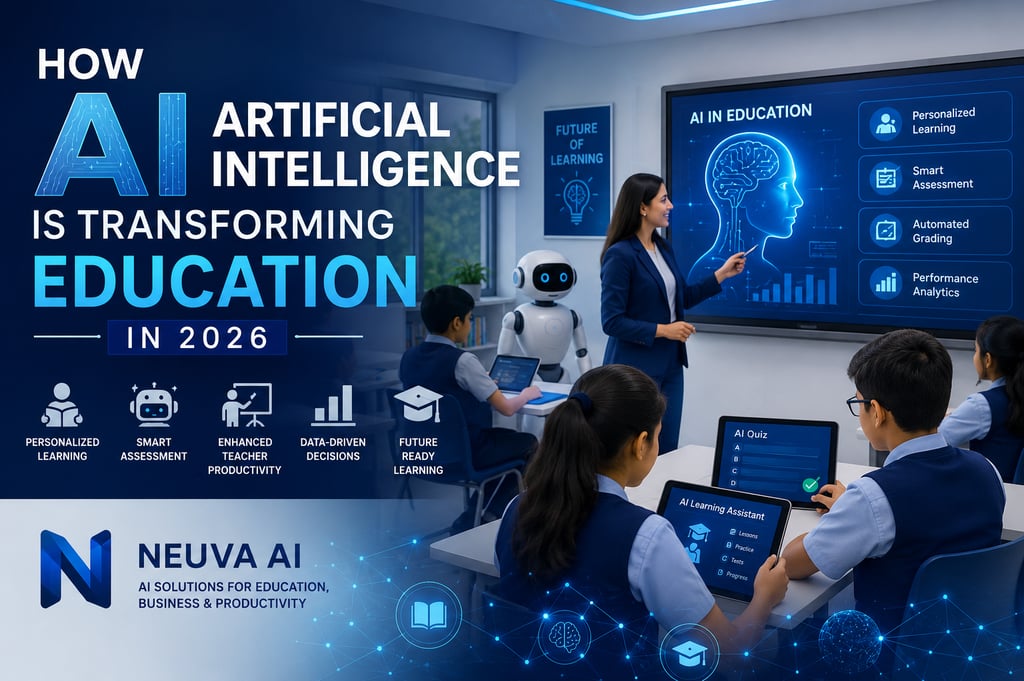
Introduction to AI in Education
As we step into 2026, artificial intelligence (AI) has emerged as a transformative force in the realm of education. The integration of AI technologies into educational settings aims to enhance learning experiences, improve teaching methodologies, and streamline administrative processes. AI's potential to facilitate personalized learning, automate routine tasks, and provide actionable insights has become increasingly recognized by educators and institutions worldwide.
Over the past decade, there has been a significant rise in the adoption of AI tools and resources in schools and universities. Innovations such as adaptive learning platforms, intelligent tutoring systems, and data analytics are redefining traditional education models. These advancements allow for customized educational experiences that cater to individual student needs, ultimately aiming to improve academic performance and engagement.
The timeline of AI advancements in education traces back to early experiments with machine learning algorithms and natural language processing. As AI technologies have matured, their applications within educational frameworks have expanded significantly. Notably, in 2020, we saw the initial development of chatbots that could answer student queries in real-time. By 2023, AI-powered analytics began to offer institutions valuable insights regarding student performance and learning behaviors. Now, as we approach 2026, the use of AI is expected to proliferate, further optimizing educational frameworks globally.
Moreover, AI serves a dual purpose by not only enhancing student experiences but also alleviating burdens on educators. Tasks such as grading and administrative duties can be automated, allowing teachers to focus more on instruction and student interaction. Consequently, AI's role in education is poised to forge stronger connections between students and educators, fostering a more dynamic and effective learning environment.
Personalized Learning Experiences
Artificial Intelligence (AI) is significantly changing the landscape of education by fostering personalized learning experiences tailored to individual student needs. By leveraging adaptive learning systems, AI creates educational environments where content is aligned with distinct learning styles and paces. This customization enables learners to progress through material at their own speed, ultimately improving comprehension and retention.
One of the standout features of AI in education is its ability to analyze vast amounts of data regarding a student’s performance, preferences, and engagement levels. Based on this analysis, AI algorithms can adjust the curriculum in real time, providing relevant resources and recommendations. For instance, platforms like DreamBox and Knewton offer students mathematical challenges that adapt not only in difficulty but also in the type of concepts presented, ensuring that each learner receives the specific support they require.
Moreover, AI-driven platforms like Carnegie Learning and Smart Sparrow utilize sophisticated algorithms to develop personalized learning paths. These platforms track individual progress and can offer immediate feedback, allowing students to grasp difficult concepts more efficiently. When students feel supported by customized educational content, their engagement increases, making them more likely to persist and succeed in their studies. Furthermore, the reduction of one-size-fits-all approaches has been linked to higher student satisfaction, as learners appreciate being recognized as individuals rather than just part of a collective group.
In summary, the integration of artificial intelligence into educational settings empowers educators to create engaging, customized learning experiences that cater to the unique requirements of each student. By facilitating personalized educational journeys, AI not only enhances academic performance but also fosters a deeper love for learning, paving the way for a more effective educational future.
AI-Powered Educational Tools
Artificial Intelligence (AI) is profoundly reshaping the educational landscape by introducing sophisticated tools tailored for diverse teaching and learning environments. Among these innovations, virtual tutors stand out as a significant advancement. These AI-driven assistants provide personalized support to students, adapting their methodologies based on individual learning styles. For example, a study in a Florida school revealed that students utilizing virtual tutoring systems improved their performance in mathematics by up to 25%, showcasing the potential of personalized learning facilitated by AI.
Another crucial component is the intelligent learning management systems (LMS), which have become integral in curating and managing educational content. These systems leverage algorithms to analyze student performance and engagement, allowing educators to fine-tune their curricula effectively. By employing an AI-powered LMS, educators can identify knowledge gaps and recommend tailored resources, which leads to enhanced comprehension. A case in point is a university in California where the implementation of an AI LMS resulted in a 15% increase in overall student satisfaction and grades.
Additionally, AI-driven content creation tools are revolutionizing how educational materials are developed. These tools utilize natural language processing to generate exam questions, summarize lengthy texts, and create interactive course materials. Such tools not only streamline the workload of educators but also ensure that content is relevant and engaging. A New York-based teaching institution reported significant time savings with the integration of AI content tools, enabling instructors to focus more on interactive, hands-on learning activities in the classroom rather than solely on content creation.
Automated Assessments and Examination Management
Artificial Intelligence (AI) is significantly reshaping the landscape of education in 2026, particularly in the realm of assessments and examination management. One of the most transformative applications of AI involves automated question paper generation, where algorithms can create tailored assessments based on individual learning paths and curriculum requirements. This technology not only streamlines the task for educators but also ensures that the questions are relevant and aligned with the learning objectives.
In addition to question generation, AI-powered smart grading systems are revolutionizing the assessment process. These systems utilize machine learning algorithms to evaluate student submissions, providing rapid, reliable evaluations while minimizing human bias. By offering immediate feedback to students, these smart grading systems enhance the learning experience, allowing educators to focus their attention on more personalized instruction instead of manual grading tasks.
Furthermore, the incorporation of advanced analytics enabled by AI in assessment management systems allows institutions to measure student performance more comprehensively. By analyzing patterns in data, educators can identify strengths and weaknesses within student populations, enabling targeted interventions and support. These insights enhance decision-making processes in curriculum optimization and personalized learning strategies, contributing to improved educational outcomes.
However, the integration of AI in automated assessments is not without its challenges. Issues surrounding data privacy, fairness in algorithm design, and the potential for over-reliance on technology must be carefully navigated. Educational institutions need to develop robust policies and guidelines to mitigate these risks while harnessing the benefits of AI. Successful implementation will ultimately hinge on balancing innovation with ethical considerations in order to enhance the educational experience.
Enhancing Teacher Productivity
Artificial Intelligence (AI) is playing an increasingly vital role in the education sector, particularly in enhancing teacher productivity. By employing various AI tools, educators can significantly streamline their workload and focus more on the aspects of teaching that require their unique human touch. One such AI innovation is adaptive learning technology, which personalizes the learning experience for students, allowing teachers to allocate their time more efficiently among their classes. These tools provide tailored resources and feedback for each student, helping teachers address individual learning gaps without dedicating excessive time to manual assessments.
In addition to personalized learning, AI-assisted lesson planning tools have emerged, offering educators optimized curriculum development that aligns with learning objectives and standards. Such tools can analyze vast quantities of educational data to suggest engaging activities and relevant content, thus simplifying the planning process and allowing teachers to dedicate more time to actual student engagement rather than logistical difficulties. Furthermore, these AI systems can adapt plans in real time based on student performance data, ensuring that lessons remain relevant and effective.
Moreover, AI facilitates a more effective management of administrative tasks that often consume teachers' time. For instance, automated grading systems can evaluate assignments and exams efficiently, providing students with rapid feedback while simultaneously freeing teachers to focus on more interactive and supportive roles within the classroom. Moreover, scheduling software powered by AI helps manage class structures and meetings, optimizing the use of available time and resources.
With the integration of these AI tools, educators benefit not only from improved organizational efficiency but also from a better work-life balance, making it possible to reduce stress and enhance collaborative efforts among faculty members. The transformative impact of AI in education transcends merely enhancement—it redefines the teaching profession significantly.
Future Trends of AI in Education
The landscape of education is set to experience profound transformation with the ongoing integration of artificial intelligence (AI) technologies. As we approach 2026, several anticipated trends will likely shape how learners, educators, and institutions interact with educational content and each other. One of the most significant developments will be the continued advancement of machine learning algorithms, which will enable personalized learning experiences tailored to the needs and preferences of each student. This adaptive learning model will not only improve engagement but also optimize learning outcomes by translating data into actionable insights.
Data analytics will also play a pivotal role in the future of education. By harnessing vast amounts of data generated through online learning platforms, AI can identify patterns in student behavior and academic performance. This will empower educators to make informed decisions about instructional strategies and curriculum development, ensuring that they effectively address areas where students are struggling. Consequently, the quality of education is expected to improve, as teaching methods evolve to incorporate data-driven approaches.
Moreover, virtual reality (VR) will likely redefine the educational experience, providing immersive learning environments that enhance understanding and retention. With AI powering these VR platforms, learners can engage in interactive scenarios that simulate real-world challenges, thereby fostering critical thinking and problem-solving skills. However, as these technologies advance, challenges such as ethical considerations and data privacy concerns will need to be addressed. The potential for misuse of student data calls for stringent regulations to protect privacy while ensuring equitable access to educational resources.
The digital divide also poses a significant challenge as AI becomes increasingly prevalent in education. Ensuring that all students have access to the necessary technology and training will be vital to prevent widening disparities in educational opportunities. As educational institutions and policymakers navigate these complexities, striking a balance between innovation and ethical responsibility will be crucial in shaping an inclusive educational landscape.
Conclusion and Call to Action
As we have explored throughout this blog post, the influence of artificial intelligence on the education sector in 2026 is profound and undeniable. The integration of AI technologies is reshaping the learning landscape, offering significant advantages such as personalized learning experiences, efficient administrative processes, and enhanced engagement through innovative tools. With AI's capabilities, educators can cater to diverse learning styles, helping students achieve their full potential while allowing teachers to focus more on instruction rather than administrative tasks.
While the advantages are substantial, it is crucial to acknowledge the challenges that accompany this rapid technological advancement. Concerns regarding data privacy, the potential for bias in AI algorithms, and the need for digital literacy among educators are imperative considerations. Addressing these issues will play a central role in ensuring that AI enhances educational practices rather than complicates them.
In order to fully harness the potential of artificial intelligence, educators, institutions, and policymakers must be proactive. Engaging with platforms such as Neuva AI can offer valuable resources and support, enabling educators to effectively integrate AI into their curriculum and institutional frameworks. By taking concerted steps towards adopting AI technologies, stakeholders can facilitate innovation in education and improve overall student outcomes.
It is essential for everyone involved in the educational sector to remain informed about the evolving role of AI and to participate actively in discussions and training related to its application. Together, as a community, it is possible to create a future where artificial intelligence serves as a cornerstone of educational excellence, driving productivity and fostering innovation for generations to come.
Contact
Reach out to neuva ai for tailored AI solutions.
Phone
Connect@neuvaai.com
+91 9759115656
© 2026. All rights reserved @NeuvaAi.
Neuva AI provides AI-powered tools for education, business productivity and workplace automation.