Benefits of AI CRM Automation for Small Businesses in 2026
AI CRM Automation is helping small businesses streamline customer relationship management, automate follow-ups and improve sales performance. By reducing manual work and providing valuable customer insights, AI-powered CRM systems enable organizations to increase efficiency, improve customer satisfaction and accelerate business growth. Learn the key benefits of AI CRM Automation and why it is becoming essential in 2026.
BUSINESS AUTOMATION
Understanding AI CRM Automation
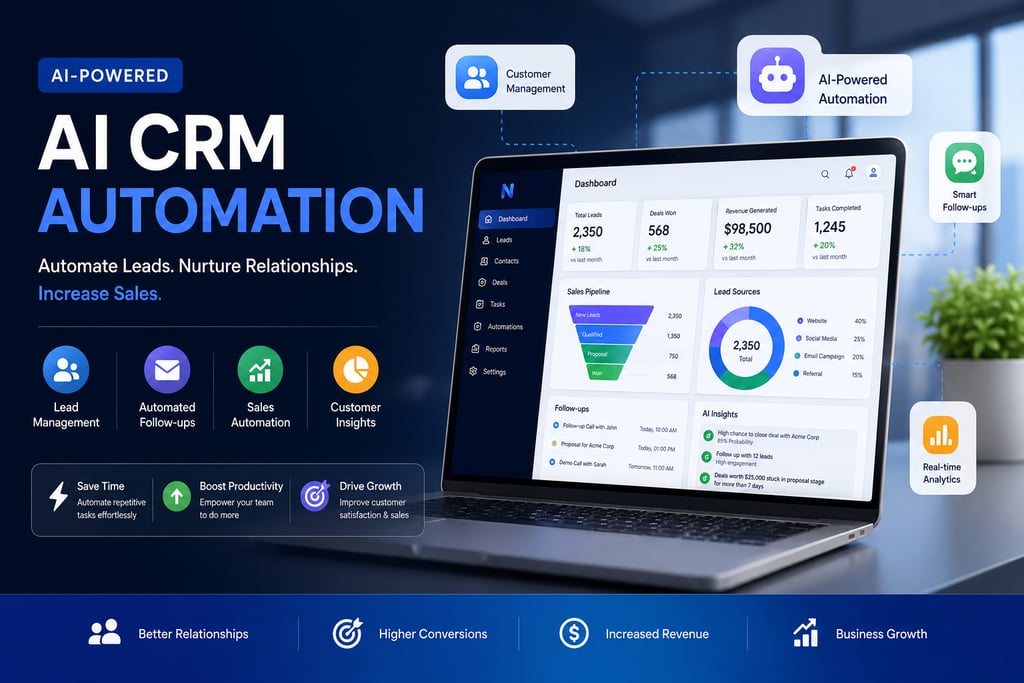
Artificial Intelligence (AI) Customer Relationship Management (CRM) automation refers to the integration of AI technologies into CRM systems, which enhances the management of a business's interactions with current and potential customers. This innovative approach automates various customer-related processes, streamlining workflows, and improving overall efficiency in client relations.
AI CRM automation encompasses a variety of intelligent technologies, with machine learning being a significant component. Machine learning algorithms analyze customer data to identify patterns and predict future behaviors, enabling businesses to tailor their marketing strategies effectively. In conjunction with automation tools, these AI technologies enhance the responsiveness of customer service operations, ensuring that inquiries and customer needs are addressed promptly and accurately.
The operation of AI CRM systems typically involves several key functionalities. Firstly, data collection and analysis are automated, allowing businesses to gather insights from customer interactions without manual input. Secondly, predictive analytics assists in identifying potential sales leads by analyzing past buying behavior and engagement data, hence enabling more targeted sales efforts. Furthermore, chatbots, powered by natural language processing (NLP), facilitate real-time customer interactions, answering queries and resolving issues instantly, thereby increasing customer satisfaction.
Moreover, AI-driven CRM systems can personalize customer experiences by providing recommendations and tailored content based on individual preferences and behaviors. This form of automation not only enhances the interaction quality between businesses and customers but also empowers employees to focus on more strategic tasks rather than routine administrative work. By integrating AI CRM automation, small businesses can not only improve their operational efficiency but also foster stronger relationships with customers, paving the way for growth and success in a competitive landscape.
The Importance of Customer Relationship Management for Business Growth
In an increasingly competitive business landscape, effective Customer Relationship Management (CRM) has emerged as a vital cornerstone for the growth of small businesses. CRM systems empower organizations to understand, engage with, and respond to customer needs, which in turn fosters loyalty and drives revenue. By streamlining communication and interactions with customers, small businesses can enhance their overall customer experience, thereby positioning themselves for sustainable growth.
One of the primary benefits of CRM is its ability to accumulate and analyze customer data. This analytical capability allows businesses to tailor their marketing strategies based on the unique preferences and behaviors of their clientele. According to recent studies, organizations that actively use CRM systems report an increase in sales by up to 29% and an increase in customer satisfaction by 20%. These statistics underscore the transformative potential that proper CRM implementation holds for small enterprises seeking to expand their market share.
Furthermore, effective CRM practices contribute to building lasting relationships between customers and businesses. When customers feel valued and understood, their loyalty tends to increase. A case study on a small retail business revealed that after implementing a robust CRM system, repeat customer purchases increased by 40% within a year. This is a clear indication of how strategic CRM efforts can yield significant dividends in terms of customer retention and revenue generation.
Moreover, CRM fosters enhanced customer engagement through personalized communication, targeted promotions, and timely follow-ups. In an era where consumers expect tailored services, businesses that leverage CRM tools can establish a competitive edge. By understanding customer journeys and touchpoints, small businesses are better equipped to align their offerings with market demand, ultimately leading to increased sales and business expansion.
Key Benefits of AI CRM Automation
AI CRM automation presents numerous advantages tailored for small businesses, significantly enhancing their operational efficiencies and overall performance. One of the primary benefits is automated lead management. By utilizing AI, small businesses can streamline the process of identifying, nurturing, and converting leads, allowing sales teams to focus their efforts on high-value prospects. Automation minimizes the risk of human error while ensuring that no lead is overlooked, thereby maximizing the potential for successful conversions.
Another critical advantage is faster customer follow-ups. With AI-powered CRM systems, businesses can promptly respond to customer inquiries and follow up on leads, ensuring a seamless interaction process. This enhanced responsiveness not only improves customer satisfaction but also increases the likelihood of retaining clients and securing repeat business.
Improved customer retention is a further benefit of AI CRM automation. By analyzing customer data, AI systems can identify patterns in behavior and preferences, enabling businesses to tailor their services and maintain meaningful engagement. Personalized communications foster loyalty, ensuring customers feel valued and understood.
Moreover, AI CRM automation leads to better sales productivity. By minimizing time-consuming manual tasks, such as data entry and report generation, sales teams can dedicate more time to high-impact activities, such as personal selling and relationship-building. This shift in focus often results in enhanced performance and increased revenue.
Additionally, businesses gain access to AI-powered insights that facilitate data-driven decision-making. Through predictive analytics and trend analysis, small businesses can uncover actionable insights that inform strategic planning and marketing initiatives, ultimately leading to a competitive advantage.
Lastly, reducing manual tasks not only decreases the chances of human error but also boosts employee morale. Automation fosters a more efficient workspace, allowing team members to engage in more meaningful and impactful work. By embracing AI CRM automation, small businesses position themselves for success in an increasingly competitive landscape.
Traditional CRM Systems vs. AI CRM Automation
When evaluating CRM systems for small businesses, a critical comparison between traditional Customer Relationship Management (CRM) systems and AI-driven CRM automation arises. Traditional CRM systems typically focus on organizing customer information and managing interactions through manual processes. Users must dedicate time to enter data, analyze reports, and implement strategies based on historical information. This can lead to inefficiencies, particularly for small businesses with limited resources.
In contrast, AI CRM automation leverages artificial intelligence to enhance the customer management process. One of the most notable differences is the level of automation. Whereas traditional systems require manual input and oversight, AI-driven systems automate repetitive tasks, such as data entry and customer follow-ups. This frees up valuable time for small business owners and sales teams, allowing them to focus on strategic initiatives rather than administrative duties.
Moreover, the ability to generate actionable customer insights marks a significant advantage of AI CRM automation over its traditional counterparts. AI systems analyze customer behavior patterns, preferences, and buying histories to provide deep insights. These insights lead to personalized marketing strategies and improved customer experiences, fostering stronger relationships with clients. With traditional systems, the analysis is often limited and may not account for all relevant data.
Lastly, adaptability is a crucial factor in the current fast-paced business landscape. Traditional CRM systems can become outdated, requiring costly upgrades and training. Conversely, AI CRM automation can continually learn and adapt to evolving market trends and customer needs, providing a proactive solution that aligns with changing business demands. Small businesses that transition to these AI-powered solutions position themselves for growth and sustained competitive advantage.
Real-World Use Cases for Small Businesses
In the dynamic landscape of small businesses, the adoption of AI CRM automation has proven to be transformative. Various industries have embraced this technology, resulting in improved operational efficiency and enhanced customer satisfaction. For instance, a local boutique in Austin, Texas, implemented AI-driven CRM tools to personalize customer interactions. According to the owner, Sarah Mitchell, "Since we incorporated CRM automation, our repeat customer rate has increased by 40%. The system helps us track preferences and make tailored recommendations, which our clients appreciate immensely." This showcases how small businesses can benefit from understanding consumer behavior through automation.
Another compelling example is a small landscaping company based in Florida. By utilizing AI CRM automation, they streamlined their scheduling and communication processes. Owner John Carter revealed, "Automating our appointment reminders and follow-ups took a significant load off my shoulders. Not only did it save me time, but it also improved our customer engagement and satisfaction levels. Our clients are happier, and our summer bookings have surged by 30%!" This illustrates how automation not only enhances customer experience but also leads to tangible growth in sales.
Additionally, an artisan bakery in Seattle adopted AI CRM software for managing its sales and customer interactions. The bakery utilized automation to analyze purchase patterns, allowing them to introduce targeted promotions for frequent buyers. Jennifer Lee, the owner, commented, "The automated CRM has changed how we approach our marketing. We had no idea how much potential our loyal customers had until we started capturing data through AI. Our last pastry promotion resulted in a 50% increase in sales over a single weekend." This example further emphasizes the diverse applicability of AI CRM systems across different sectors and their significant impact on business outcomes.
AI and Sales Conversion Improvement
In the increasingly competitive landscape of small businesses, optimizing sales conversion rates is essential for sustainable growth. Artificial Intelligence (AI) plays a pivotal role in enhancing sales strategies through a multitude of advanced methods, leading to improved conversion rates. One of the core advantages of AI in Customer Relationship Management (CRM) systems is its ability to facilitate personalized marketing. By analyzing customer data, AI can create highly targeted marketing campaigns that resonate with individual customer preferences and behaviors. This personalization increases the likelihood of converting leads into loyal customers.
Additionally, behavior analysis is a critical component of AI-driven CRM. AI tools can track and analyze customer interactions, allowing businesses to understand patterns and predict future behavior. With insights gained from this data, sales teams can tailor their approaches to match the unique needs and buying habits of their prospects, enhancing the overall customer experience and facilitating higher conversion rates.
Furthermore, predictive analytics is instrumental in forecasting potential sales opportunities and identifying leads that are more likely to convert. By leveraging historical data, AI can assess which factors influence purchasing decisions. This foresight enables sales teams to prioritize high-potential leads, streamlining their efforts towards those who have a higher propensity to engage and purchase.
Real-time feedback provided by AI systems also empowers sales professionals to adapt their strategies promptly. By receiving instant insights into customer responses, sales teams can refine their pitches and address any concerns effectively, which is crucial for closing deals. Furthermore, AI CRM platforms can automate follow-ups and reminders, ensuring that no opportunity is missed.
In conclusion, by integrating AI-driven CRM tools into their sales processes, small businesses can significantly enhance their sales conversions. The combination of personalized marketing, behavior analysis, predictive analytics, and real-time feedback not only shapes robust sales strategies but ultimately leads to an increase in closure rates.
Future CRM Trends in 2026
As we approach the year 2026, the landscape of Customer Relationship Management (CRM) systems is poised for significant transformation, driven by emerging technologies and evolving customer expectations. Artificial Intelligence (AI) will play a pivotal role in shaping the future of CRM, enabling businesses to automate processes and enhance customer interactions. One key trend will be the integration of advanced AI capabilities, which will allow CRM systems to analyze vast amounts of customer data in real-time, providing actionable insights that can significantly improve customer engagement strategies.
Moreover, customer expectations are escalating; they now demand personalized experiences that transcend traditional service offerings. To meet these expectations, CRM solutions will likely incorporate machine learning algorithms that predict customer behaviors and preferences. This predictive capability will empower businesses to offer timely recommendations and personalized communications, fostering greater customer loyalty and satisfaction.
Another emerging trend is the shift towards omnichannel communication. By 2026, businesses will need CRM systems that seamlessly integrate various communication channels, such as social media, email, and chatbots, to ensure consistent and coherent interactions with customers. This integration will not only enhance the customer experience but also enable businesses to gather a holistic view of customer journeys across multiple platforms.
To position themselves favorably amidst these impending changes, small businesses should invest in CRM systems that prioritize flexibility and scalability. Preparing for advancements in AI and data analytics will be critical, as well as understanding the significance of data privacy and security to build trust with customers. By adopting a proactive stance and staying informed about these CRM trends, small businesses can effectively adapt their strategies and continue to thrive in an increasingly technology-driven market.
Internal Links
AI CRM Automation Page
Business Automation Page
Contact
Reach out to neuva ai for tailored AI solutions.
Phone
Connect@neuvaai.com
+91 9759115656
© 2026. All rights reserved @NeuvaAi.
Neuva AI provides AI-powered tools for education, business productivity and workplace automation.