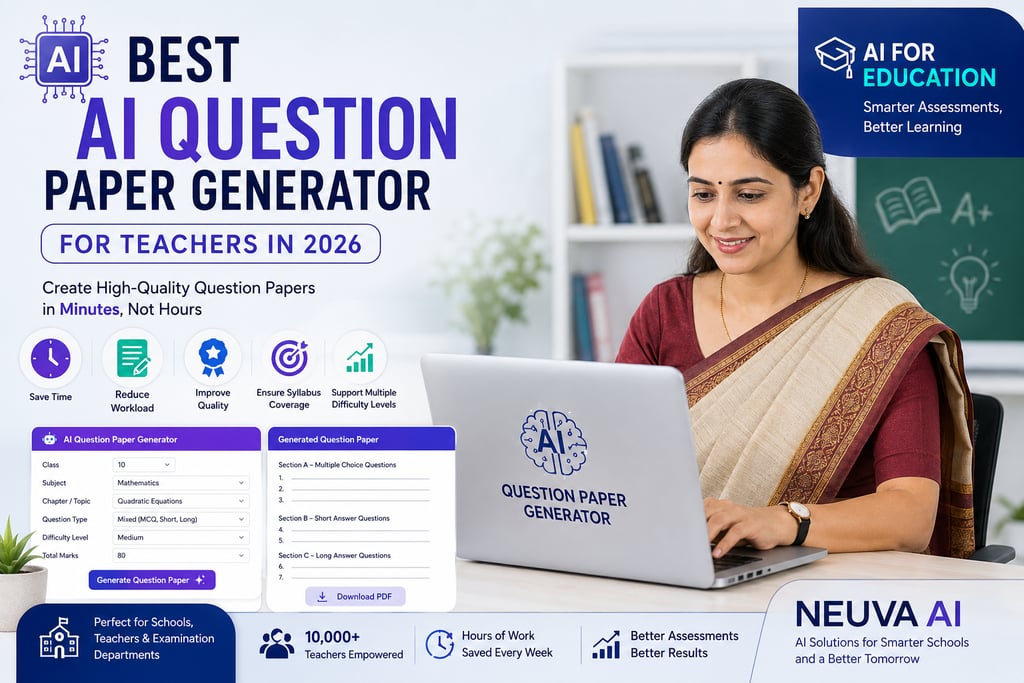
Best AI Question Paper Generator for Teachers in 2026
Discover how an AI Question Paper Generator helps teachers create exam papers faster, improve assessment quality, and save valuable preparation time in 2026.
AI IN EDUCATION
Introduction: Challenges Teachers Face in Preparing Question Papers
Creating question papers is an essential yet often daunting task for educators. Teachers frequently encounter several challenges when preparing assessments manually, significantly impacting their efficiency and effectiveness. One of the most pressing issues is time constraints. With a multitude of responsibilities ranging from delivering lectures to grading assignments, teachers often struggle to allocate sufficient time for crafting high-quality question papers. This lack of time can lead to rushed and potentially inadequate assessments that do not accurately reflect students' understanding.
Workload is another significant challenge educators face. The preparation of question papers entails a thorough understanding of curriculum requirements, learning objectives, and assessment standards. Coupled with other commitments, this can become overwhelming. As a result, the quality of the assessments may suffer, affecting students' learning experiences. Furthermore, generating a variety of questions to cater to different learning styles requires considerable effort and expertise, which can be hard to achieve under tight schedules.
The difficulty of maintaining quality and standardization throughout question papers presents yet another hurdle. Educators need to ensure that assessments are not only coherent and relevant but also equitable for all students. Inconsistent questions can lead to misunderstandings regarding the assessment's objectives and undermine the integrity of the educational process. Consequently, these challenges necessitate finding more efficient solutions to streamline question paper preparation.
Therefore, as the landscape of education evolves, it is imperative to adopt innovative methods for addressing these issues. Utilizing technology, such as AI-driven question paper generators, can alleviate some of the burdens teachers face. Such tools promise to enhance efficiency, allowing educators to focus more on teaching while ensuring high-quality assessments that meet educational standards.
What is an AI Question Paper Generator?
An AI question paper generator is an advanced software tool that utilizes artificial intelligence (AI) algorithms to create structured assessment questions for educational purposes. The technology behind these generators harnesses the power of machine learning and natural language processing to analyze existing educational content, understand concepts, and develop relevant questions tailored to specific subjects and difficulty levels.
The core functionality of an AI question paper generator begins with the input data, which includes textbooks, lecture notes, syllabi, and existing question banks. This data is processed using algorithms designed to identify key topics, concepts, and associated learning outcomes. The AI engine then synthesizes this information to craft questions ranging from multiple-choice to fill-in-the-blank and essay formats. The generation of these questions is based on various parameters specified by teachers, such as topic selection, difficulty level, and question types.
One of the most significant advantages of AI question paper generators is their ability to generate assessments quickly and efficiently. Educators can input desired criteria, and within moments, receive a comprehensive set of questions that reflect the learning objectives. This capability not only saves valuable time but also ensures a diverse array of questions, minimizing the risk of repetition and bias that often occurs in manually created assessments.
Furthermore, these tools can continually improve their output quality through feedback and data analytics. By tracking performance outcomes from generated assessments, AI algorithms can refine their understanding of effective question construction, ensuring that they remain aligned with educational standards and rigorous assessment practices.
Benefits of Using an AI Question Paper Generator
Employing an AI question paper generator offers numerous advantages that significantly enhance the educational experience for both teachers and students. One of the primary benefits is the considerable time savings it provides. Teachers often spend hours crafting exam questions that align with curriculum standards. An AI-powered tool can automate this process, generating well-structured and relevant questions in a fraction of the time, thereby allowing educators to focus their efforts on teaching and student engagement.
Another significant advantage is the reduction of teacher workload. Manual question formulation can lead to burnout, especially when balancing grading, lesson planning, and instructional responsibilities. By using an AI question paper generator, educators can streamline their task management, ensuring they produce effective assessments without feeling overwhelmed.
Furthermore, these advanced tools can improve the quality of questions presented to students. AI systems utilize algorithms that analyze successful question patterns, ensuring that the generated queries are both challenging and appropriate for the intended learner demographic. This leads to a more effective assessment structure, driving a deeper understanding of key concepts.
In addition to the quality of questions, AI question paper generators ensure comprehensive syllabus coverage. By automatically referencing required curriculum topics, these tools can balance assessments across diverse subject areas and content types, ensuring that all necessary material is tested evenly. This comprehensive approach helps educators maintain high standards in their evaluations.
Lastly, AI question paper generators accommodate various difficulty levels, providing a tailored experience for students. This capability allows teachers to create differentiated assessments that cater to varying student abilities, ultimately enhancing learning outcomes. By generating questions that range from basic to advanced, educators can better assess student knowledge and understanding.
Practical Use Cases for Schools and Teachers
As education continues to evolve through technological advancements, AI question paper generators have begun to play a critical role in enhancing assessment processes across various educational settings. Schools and teachers can effectively integrate these tools to streamline the creation of tests and optimize evaluation standards.
One notable implementation occurred at a public high school, where educators adopted an AI-driven question paper generator to reduce the time spent on developing assessments. Teachers reported a significant increase in efficiency, allowing them to focus more on student engagement and instruction. For example, instead of manually crafting each exam, a teacher could input the preferred topics and difficulty levels, and the software would produce a set of tailored questions. This real-time adaptability ensures that assessments remain aligned with the curriculum while meeting diverse learner needs.
Another practical use case emerged in a private elementary school, where teachers used an AI question paper generator to create customized quizzes for students with varying proficiency levels. By utilizing this technology, educators were able to offer differentiated assessments, which catered to each student's unique learning trajectory. It allowed teachers to foster a more inclusive environment by assessing all students fairly, thus assisting in identifying areas that required targeted support.
Moreover, the feedback from both students and teachers highlighted the enhanced engagement levels during assessments generated by AI tools. Automated question paper generators also incorporate analytics functions that provide insights into areas where students may struggle, allowing for timely instructional adjustments. Through these real-world applications, it is evident that the integration of AI question paper generators fosters a more dynamic assessment landscape for both educators and students.
AI in Examination Departments: Managing Assessments Efficiently
Artificial intelligence is profoundly transforming how examination departments manage assessments, leading to enhanced efficiency and effectiveness in educational institutions. The implementation of AI technologies is assisting in various capacities, from scheduling examinations to generating diverse types of assessments tailored to individual educational requirements.
One of the critical roles AI plays is in scheduling. Traditional methods can often be time-consuming and prone to errors. AI algorithms can automate this process by analyzing various factors such as student availability, room capacities, and instructor schedules, allowing for optimized timetabling of assessments. This automation not only saves time but also reduces administrative burdens on personnel, enabling them to focus on more strategic tasks.
Furthermore, AI systems are capable of creating a wide range of assessments including multiple-choice questions, essay prompts, and practical tasks based on curriculum standards and learning objectives. By utilizing data from previous exams and student performances, AI can generate assessments that are not only reliable but also diverse, providing a rounded evaluation of student capabilities.
The analytical capabilities of AI extend to performance tracking, where it can monitor student progress and outcomes in real-time. By analyzing large data sets, AI-driven tools can identify trends, strengths, and weaknesses in student performance. This information can be invaluable for teachers and administrators as it facilitates data-driven decision-making aimed at improving educational strategies and outcomes.
Moreover, AI solutions enhance academic integrity through advanced monitoring systems that can detect anomalies in assessment processes. By ensuring the authenticity of assessments, educational institutions can maintain the credibility of their evaluation systems, fostering a trustworthy academic environment.
In summary, the integration of AI in examination departments is revolutionizing assessment management by streamlining scheduling, diversifying assessment types, analyzing performance metrics, and ensuring academic integrity, thereby paving the way for efficient educational practices in the future.
Comparison: Manual Question Paper Creation vs. AI Question Paper Generator
Creating examination papers has traditionally been a manual process, relying heavily on the expertise and judgment of educators. However, as technology advances, educators increasingly turn to AI question paper generators. This section highlights key differences between manual creation and AI-assisted methods, helping teachers assess which approach may better serve their needs.
Efficiency: Manual question paper creation can be labor-intensive, often taking hours or even days to compile questions, format, and finalize the document. In contrast, AI question paper generators can produce a complete set of questions in mere minutes, utilizing algorithms to generate varied and high-quality content based on predefined criteria.
Time Savings: Teachers often face tight schedules with numerous responsibilities. The time saved by utilizing an AI question paper generator can be substantial, allowing them to devote attention to curriculum planning and student interaction, rather than administrative tasks associated with exam preparation.
Error Rates: Manual processes are susceptible to human error—typos, formatting issues, or incorrectly posed questions can occur, potentially impacting a student's performance. On the other hand, an AI question paper generator minimizes these risks by applying systematic checks and balances, ensuring high-quality production of examination materials.
Overall Effectiveness: While manual question writing allows for a personalized touch that reflects the educator's style, AI-generated content can provide a broader range of topics and difficulty levels, tailored to specific learning objectives. Incorporating in-depth analytics, AI systems can assess the effectiveness of questions and give feedback, thus promoting continuous improvement in the question paper process.
Transitioning from traditional methods to AI-assisted solutions can enhance the teaching experience. By understanding the differences in efficiency, time savings, accuracy, and overall effectiveness, educators can make informed decisions about whether to embrace AI question paper generators in their assessment processes.
The Future of AI in School Examinations
The integration of artificial intelligence (AI) in educational assessments is poised to significantly transform the landscape of school examinations in the coming years. With advancements in machine learning, natural language processing, and data analytics, AI technologies are beginning to reshape how assessments are constructed, administered, and evaluated. This evolution presents numerous possibilities for educators and students alike, fundamentally changing traditional examination practices.
One notable trend is the emergence of AI question paper generators, which leverage algorithms to create customized assessments tailored to specific learning outcomes and student needs. Such tools allow teachers to generate diverse and dynamic question sets swiftly, promoting a more personalized and engaging examination experience for students. Furthermore, these generators can adapt to various educational standards and curricular requirements, providing significant flexibility in assessment design.
Additionally, AI-driven analytics can provide valuable insights into student performance and understanding. By analyzing data collected from assessments, educators can identify patterns and trends that inform instructional strategies and support targeted interventions. This data-driven approach not only enhances teaching efficacy but also promotes the overall academic success of students.
Moreover, there are implications for fairness and bias in assessments. AI has the potential to identify and minimize unintentional biases in question design, ensuring a more equitable evaluation process for all students. However, there is also a pressing need for vigilance concerning ethical considerations and the transparent implementation of AI in educational settings.
As we look towards the future, AI's role in school examinations will continue to evolve, with innovations paving the way for more efficient, effective, and fair assessment practices. Educators must remain informed and adaptable to leverage these advancements fully, ensuring that AI truly enhances the educational assessment landscape.
Frequently Asked Questions About AI Question Paper Generators
AI question paper generators are becoming increasingly popular among educators. This section addresses some common queries regarding these innovative tools.
1. What are AI question paper generators?
AI question paper generators are software tools designed to assist teachers in creating assessments and examination papers automatically. Utilizing artificial intelligence, these generators can produce a wide range of question types, including multiple-choice questions, fill-in-the-blanks, and essay prompts tailored to various subjects and grade levels.
2. How do AI question paper generators work?
These systems leverage machine learning algorithms and vast databases of educational content. By analyzing specifications set by the teacher, such as subject matter, difficulty level, and question format, the AI generates high-quality questions that align with educational standards. This automation significantly reduces the time teachers spend on assessment preparation.
3. Can AI question paper generators be customized?
Yes, most AI question paper generators offer customization options. Educators can specify different parameters, including the type of questions needed, the number of questions per topic, and the grading criteria. This adaptability ensures that the generated assessments meet specific curriculum requirements.
4. Are AI question paper generators reliable?
While AI question paper generators are designed to create accurate and relevant questions, it is crucial for educators to review the generated content. These tools are not infallible and may produce questions that require adjustment or refinement before being used in a classroom setting.
5. What are the benefits of using AI question paper generators?
The primary benefits include time savings, consistency in question quality, and the ability to create assessments that are more aligned with learning outcomes. By relieving teachers from the manual task of question creation, these tools allow them to focus more on teaching and engaging with students.
Conclusion: Embracing AI-Powered Assessment Solutions
In an era where technology significantly influences educational methodologies, the adoption of AI-powered assessment solutions has become increasingly essential for teachers and educational institutions. Through the integration of tools such as neuva ai, educators can streamline the process of generating high-quality question papers tailored to their curriculum and student needs. This not only enhances assessment efficiency but also allows for greater customization, enabling educators to focus on specific learning objectives.
The advantages of utilizing AI in educational assessments are significant. First and foremost, AI-powered tools minimize the time required for teachers to develop assessments, freeing up valuable hours that can be redirected towards interactive teaching and supporting student learning. Moreover, these systems employ sophisticated algorithms that adapt to various educational standards, ensuring that the assessments generated are aligned with the desired learning outcomes.
Furthermore, AI tools can facilitate personalized learning experiences. By analyzing students' performance data, they can provide insights that enable teachers to identify learning gaps and tailor their teaching strategies accordingly. This capability not only promotes a more individualized approach to education but also fosters a more engaged learning environment conducive to student success.
As we look ahead to 2026 and beyond, it is clear that embracing AI-driven solutions, such as those offered by neuva ai, can significantly transform the landscape of educational assessment. We encourage schools and educators to explore the potential of these sophisticated technologies to enhance the quality and effectiveness of their evaluation processes. By adopting such innovative solutions, the educational sector can better prepare itself for the challenges of the future while enriching the learning experiences of students.
Explore More AI Tools
Contact
Reach out to neuva ai for tailored AI solutions.
Phone
Connect@neuvaai.com
+91 9759115656
© 2026. All rights reserved @NeuvaAi.
Neuva AI provides AI-powered tools for education, business productivity and workplace automation.