Exam Paper Generator AI: How Teachers Can Create Better Question Papers in Minutes (2026)
Creating high-quality question papers manually takes significant time and effort. Exam Paper Generator AI simplifies this process by helping teachers generate balanced assessments, Bloom's Taxonomy-based questions and competency-focused exam papers within minutes. Learn how AI is transforming assess
AI IN EDUCATION
What is Exam Paper Generator AI?
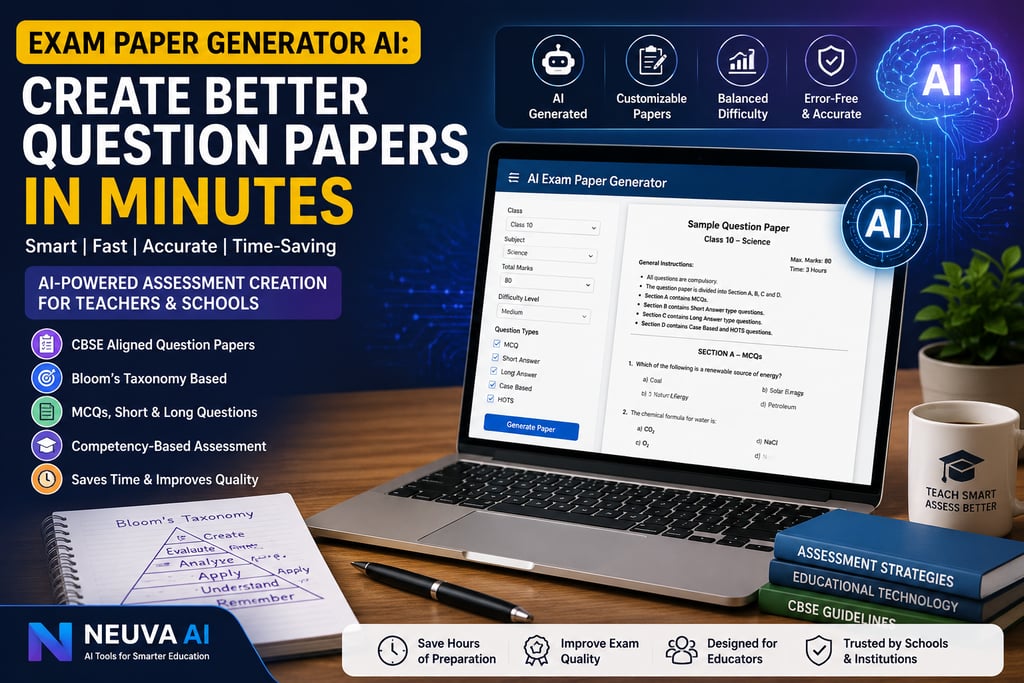
An Exam Paper Generator AI represents an innovative fusion of artificial intelligence technology and educational assessment tools. This advanced software enables teachers to efficiently create a variety of examination materials, such as test questions, quizzes, and worksheets, tailored to meet diverse educational standards and learning objectives. By leveraging algorithms capable of analyzing vast datasets of existing questions and curriculum requirements, this technology automates the question creation process significantly.
The primary function of an exam paper generator AI lies in its ability to generate targeted and diverse assessment items. Teachers can input specific parameters, such as the subject matter, difficulty level, and type of question, which the AI then processes to produce a range of educational materials. This capability not only saves educators valuable time but also ensures a broader coverage of topics and question formats. The AI can create multiple-choice questions, true/false items, and short answer questions, facilitating varied assessment strategies.
Moreover, the generator can adapt to different educational standards or curricula, allowing teachers worldwide to utilize its features according to their specific guidelines or requirements. One of the notable features of the exam paper generator is its ability to customize assessments. Educators can modify the generated questions, ensuring they align with their teaching styles or classroom environments. This can enhance the relevance and relatability of the assessments for students, thus improving educational outcomes.
In essence, an exam paper generator AI not only streamlines the assessment creation process but also enriches it by providing teachers with actionable insights and customizable options. As educational landscapes continue to evolve, such AI tools represent a significant progression in facilitating effective teaching and learning methodologies.
Why Teachers Need AI for Assessment
Creating assessment materials is a critical task for educators; however, this process often presents considerable challenges. Many teachers find themselves constrained by time, as the demands of lesson planning, grading, and administrative duties can make it difficult to devote sufficient attention to crafting high-quality assessment questions. This time crunch results in rushed assessments that may not adequately evaluate student understanding, ultimately hindering the educational process.
Additionally, maintaining consistency in question quality is another significant hurdle. While experienced teachers are capable of generating effective questions, the quality can fluctuate dramatically from one assessment to another. Such variability can lead to confusion among students and create an inequitable assessment environment. The introduction of AI-driven solutions like an exam paper generator can help address these inconsistencies by creating well-structured questions tailored to specific learning objectives.
Moreover, teachers need to consider the diverse needs of their students. Each learner has unique strengths and weaknesses, and crafting assessments that cater to a broad spectrum of abilities can be both time-consuming and complex. AI technology offers the potential to design differentiated assessments, allowing educators to provide inclusive and personalized materials that reflect the varied learning profiles of their students.
Lastly, the necessity of keeping assessment content current cannot be overstated. With ever-changing curricular standards and educational regulations, it is essential for teachers to develop assessments that reflect the most relevant content. By leveraging AI, educators can ensure their assessments incorporate the latest information, techniques, and subject matter knowledge, thus preparing students adequately for future challenges.
Benefits of Exam Paper Generator AI
The advent of Exam Paper Generator AI presents a transformative approach for educators in creating question papers. One of the principal benefits is the significant increase in efficiency. Traditional paper creation can consume hours of a teacher's time as they sift through curriculum materials and design questions manually. By leveraging AI, educators can generate high-quality exam papers in mere minutes, allowing them to focus on critical teaching responsibilities and student interactions.
Moreover, AI-driven technology enhances the quality of the questions produced. These generators utilize advanced algorithms to ensure that questions are not only relevant to the subject matter but also vary in difficulty levels, catering to all learners. For example, an AI can produce a mixture of multiple-choice, short answer, and essay questions that align with standardized testing frameworks, thus maintaining educational integrity.
Another notable advantage is the extensive customization options available for teachers. Exam Paper Generator AI allows the integration of specific learning objectives, themes, and even school branding into the generated papers. This degree of customization ensures that the assessments are tailored to the unique needs of a classroom, fostering an environment that promotes effective evaluation.
Lastly, the student assessment experience is greatly enhanced with AI-generated exam papers. With the ability to produce diverse question types and formats, students are better equipped to demonstrate their understanding of the material. Furthermore, such technology can facilitate immediate feedback mechanisms, enabling teachers to identify learning gaps promptly. By streamlining the assessment process, educators can address students' needs more effectively and improve learning outcomes overall.
AI vs Traditional Question Paper Creation
In the realm of education, the process of creating question papers has historically involved significant time and effort from teachers. Traditional methods often require educators to spend hours selecting questions, formatting papers, and ensuring a balanced representation of topics. In contrast, AI-generated question papers offer a revolutionary alternative that can drastically reduce this preparation time. Teachers can create comprehensive question sets in mere minutes, allowing them to focus on other pedagogical tasks such as lesson planning and student engagement.
One of the most noteworthy distinctions between AI-generated and traditionally created question papers is consistency. AI systems utilize algorithms that ensure a uniform standard across all questions. This consistency minimizes discrepancies that may arise when different educators prepare papers on the same subject matter. Consequently, AI can produce questions that adhere closely to learning objectives, thereby enhancing educational integrity.
Moreover, the flexibility of updates is another advantageous facet of AI-generated content. Traditional question creation typically necessitates a manual review and amendment process, which can be labor-intensive. In contrast, AI can quickly integrate updated curriculum materials or adjust difficulty levels based on changing educational standards. Teachers can request revisions in real time, thus maintaining the relevance of assessment materials without extensive delays.
Additionally, variety in question types is notably enriched through AI. While traditional methods may yield a limited range of question formats determined by the teacher’s knowledge and creativity, AI systems can generate multiple formats such as multiple-choice, true/false, and open-ended questions. This diversity facilitates a more comprehensive assessment of student understanding.
| Aspect | AI-Generated Questions | Traditional Questions |
|---|---|---|
| Preparation Time | Minutes | Hours |
| Consistency | High | Variable |
| Ease of Updates | Instant | Manual |
| Variety | Extensive | Limited |
These comparisons highlight the effectiveness of AI in revolutionizing the creation of question papers, ultimately providing teachers with robust tools to enhance the educational experience while simplifying administrative burdens.
Bloom's Taxonomy and AI
Bloom's Taxonomy, created by Benjamin Bloom and his collaborators in the 1950s, serves as a hierarchical framework for categorizing educational goals and objectives. It delineates various levels of cognitive learning, which include knowledge, comprehension, application, analysis, synthesis, and evaluation. This taxonomy provides educators with a structured approach to designing curriculum and assessments, promoting deeper understanding and mastery of subjects among students.
In the modern educational landscape, the integration of artificial intelligence (AI) offers a unique opportunity to enhance the efficacy of assessments aligned with Bloom's Taxonomy. AI-powered exam paper generators can create diverse questions targeting different cognitive levels, ensuring that assessments are more comprehensive and tailored to the abilities of learners. For instance, a generator could produce simple recall questions for the knowledge level while simultaneously crafting complex scenario-based questions that require analysis and synthesis.
The versatility of AI in question design enables educators to provide a more balanced evaluation of student understanding. By utilizing AI tools, teachers can easily prepare assessments that reflect not only the basic knowledge acquired by their students but also their ability to apply, analyze, and evaluate information critically. Furthermore, this automated approach saves educators significant time in question formulation, allowing them to focus on instructional strategies and student engagement.
Moreover, with the capability to adapt and learn from previous assessments, an AI exam paper generator can refine its output over time, continually improving the alignment with educational standards. By fostering an environment where questioning aligns with cognitive skills outlined in Bloom's Taxonomy, AI enhances learning outcomes significantly. Teachers can confidently utilize AI to generate nuanced assessments that challenge students at various cognitive levels, ultimately leading to a more effective educational experience.
Competency-Based Question Papers
Competency-based assessments have gained prominence in education as they focus on evaluating students' abilities to apply knowledge and skills in real-world scenarios. Unlike traditional assessments, which often prioritize memorization and rote learning, competency-based evaluations center on evaluating whether students can demonstrate their understanding through practical application. This shift towards competency-based question papers promotes deeper learning and ensures that students are better prepared for their future careers.
In competency-based assessments, the focus is placed on essential skills that align with educational standards and real-world expectations. These assessments often include a variety of question formats, including problem-solving tasks, case studies, and simulations that require students to engage critically with content. Consequently, these assessment types are more tailored to measure not only content knowledge but also higher-order thinking skills such as analysis, synthesis, and evaluation.
The integration of artificial intelligence (AI) into the generation of competency-based question papers presents significant advantages for educators. AI systems can analyze curricular objectives and educational standards to create questions that cater to the specific competencies desired. By utilizing machine learning algorithms, AI can generate diverse questions that assess a student’s ability to perform tasks that reflect real-world situations. This functionality saves educators valuable time, allowing them to deliver more targeted and relevant assessments that benefit both teaching and learning processes.
Moreover, AI can adapt the difficulty of questions based on individual student performance, ensuring that each learner is challenged appropriately. This adaptability is particularly beneficial in diverse classrooms where students may have varying levels of understanding and skill. With AI-driven question paper generation, teachers can focus on facilitating learning while ensuring that assessments are effective measures of students' competencies.
How Schools Can Use AI for Assessments
The integration of artificial intelligence (AI) into school assessments can significantly enhance the way educational institutions evaluate student performance. To effectively utilize AI tools in assessments, schools should begin by selecting the right AI assessment tool that aligns with their specific needs. It is crucial to assess features such as customization options, user-friendliness, and the ability to generate various question types. Schools should also consider tools that provide analytics capabilities to interpret assessment results, aiding in data-driven decision-making.
Integrating AI into existing curriculums involves a thoughtful approach. AI assessment tools should complement traditional teaching methods rather than replace them. This means schools can incorporate these tools into regular quiz formats, homework, and even standardized testing scenarios. In doing so, educators can create a seamless experience where AI assists in grading and provides immediate feedback to students, fostering a more interactive learning environment.
Training teachers to effectively utilize AI assessment tools is another essential step. Schools should organize professional development workshops that not only cover the functionalities of the AI tools but also demonstrate best practices for their implementation. Educators should feel competent and confident in using these tools to maximize their benefits. Moreover, ongoing support from tech specialists can help teachers navigate challenges as they become accustomed to the new system.
Success stories from schools that have adopted AI solutions, such as Neuva AI, can serve as inspiration and provide practical insights. For instance, some institutions have reported improved student engagement and performance metrics after integrating AI into their assessments. By sharing these positive outcomes within a community of educators, schools can foster an environment that embraces technological advancements, ultimately benefiting students and improving educational outcomes.
Frequently Asked Questions
As educators increasingly embrace the use of AI in education, particularly for creating exam papers, several questions frequently arise. Understanding the functionality and implications of using AI-generated questions is crucial for informed decision-making.
One common inquiry pertains to the reliability of AI-generated questions. Educators often wonder if these questions are as valid and rigorous as those created by human experts. It is essential to note that AI systems are designed to analyze vast datasets, generating questions that adhere to curriculum standards and learning outcomes, which often lends to a reliable assessment of student knowledge.
Another concern centers on cost considerations. Implementing AI-driven solutions can initially appear costly; however, once the system is in place, the long-term savings from reduced time spent on question formulation and increased efficiency can be significant. Many institutions find that the initial investment in AI tools pays off quickly through the enhanced productivity of teaching staff.
Data security is a critical factor as well, especially in today’s digital landscape. Schools must ensure that the AI tools they choose comply with data protection regulations. Most reputable AI exam paper generators prioritize student privacy by implementing robust security measures to protect sensitive information.
Customization capabilities also deserve attention. Many AI platforms allow for a tailored approach, enabling educators to input specific learning goals, difficulty levels, and even question types, which can result in highly personalized exam papers that suit their instructional methods.
Finally, integration with existing systems is a topic of interest. Educators should seek AI solutions that can easily interface with their current learning management systems. This interoperability can streamline the process of generating and administering exams, allowing seamless transitions from question creation to student assessment.
Conclusion
In the rapidly evolving landscape of education, the integration of technology such as exam paper generator AI is becoming increasingly essential for teachers. This innovative solution not only automates the creation of question papers but also enhances their quality, allowing educators to craft assessments that are more aligned with their curriculum needs and the diverse learning styles of students.
The advantages of utilizing AI-powered tools are numerous. They save teachers valuable time by generating questions tailored to specific subjects and difficulty levels, enabling them to focus more on instruction and personalized student engagement. Furthermore, the ability to produce a variety of assessment formats ensures a more comprehensive evaluation of student knowledge and skills. As standardized testing becomes more prevalent, these tools can help maintain high standards while ensuring fairness and accessibility.
As we consider the future of educational assessments, it is clear that adopting AI solutions like exam paper generator AI is not just an option but a necessity. Educators are encouraged to explore the available tools through platforms such as neuva ai, which provides easy-to-use interfaces for generating high-quality question papers with minimal effort. This approach not only streamlines the assessment process but ultimately contributes to improving educational outcomes.
As we move forward, it is imperative that educational institutions embrace these technological advancements, thereby fostering an environment of innovation and excellence in teaching and learning. By leveraging AI, educators can ensure they are equipped for the demands of modern education, enhancing both their assessment capabilities and the overall learning experience for students.
🔗 Internal Links
Link this article to:
Contact
Reach out to neuva ai for tailored AI solutions.
Phone
Connect@neuvaai.com
+91 9759115656
© 2026. All rights reserved @NeuvaAi.
Neuva AI provides AI-powered tools for education, business productivity and workplace automation.