How Small Businesses Can Reduce Costs with AI Automation in 2026 | Neuva AI
Discover how small businesses can reduce operational costs using AI automation. Learn how AI improves productivity, automates tasks, enhances customer service, and helps businesses grow efficiently in 2026.
BUSINESS & AI AUTOMATION
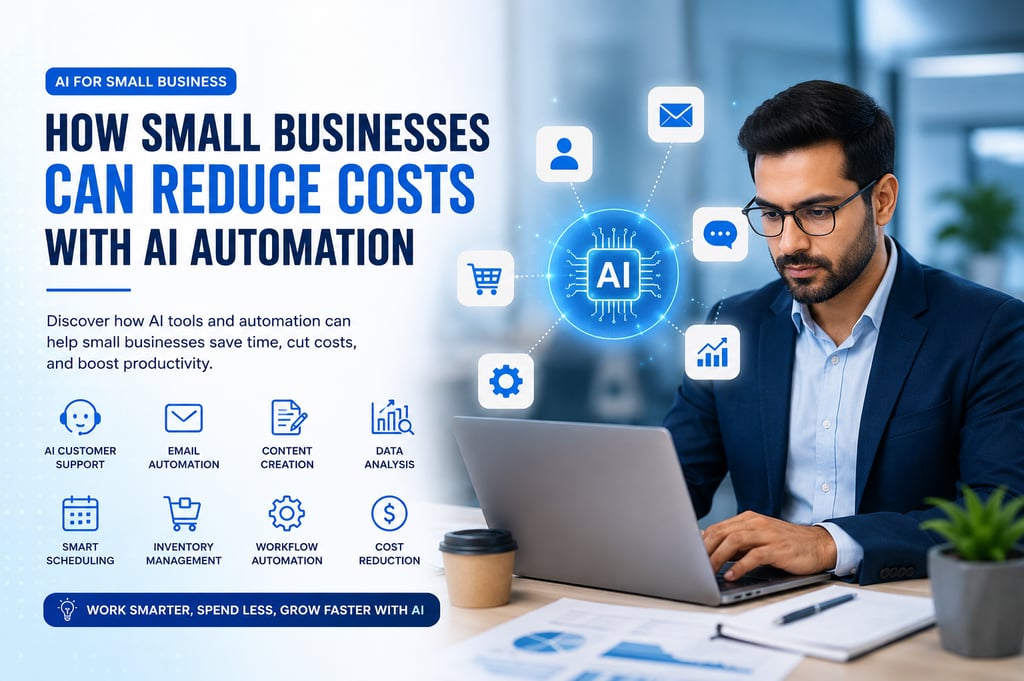
Introduction to AI Automation in Small Businesses
Artificial Intelligence (AI) automation is a transformative technology that is reshaping the landscape for small businesses across various industries. Defined as the use of algorithms and software to perform tasks that typically require human intelligence, AI automation encompasses a wide array of applications. For small enterprises, integrating AI solutions can lead to significant cost reductions and enhanced operational efficiency.
The significance of AI automation lies in its ability to optimize processes that might be labor-intensive or time-consuming when handled manually. By leveraging machine learning, data analytics, and robotics, small businesses can streamline workflows, reduce errors, and maximize resource allocation. This not only allows for a decreased operational expenditure but also frees up employees to focus on higher-value activities, ultimately driving productivity.
For instance, automating routine administrative tasks such as scheduling, invoicing, and customer relationship management can transform how small businesses operate. The time and labor saved from these automated processes can be reallocated towards strategic initiatives that promote growth and innovation. Moreover, AI tools can provide valuable insights into customer behavior and market trends, aiding businesses in making informed decisions that enhance competitiveness.
Small businesses are often constrained by limited resources; therefore, the integration of AI automation stands as a compelling solution to the traditional challenges they face. This technology not only supports cost-saving measures but also fosters a more agile and responsive business structure. As we delve deeper into the specific applications of AI automation, it becomes clear that adopting these solutions is not merely a trend — it is a pivotal strategy for small businesses aiming to thrive in today's digital economy.
AI in Customer Support: Enhancing Service and Reducing Costs
In recent years, artificial intelligence (AI) has remarkably transformed customer support for small businesses, enhancing service levels while simultaneously reducing operational costs. By deploying innovative tools such as chatbots and virtual assistants, businesses can offer immediate assistance to their clientele, ensuring that inquiries are addressed promptly and efficiently.
Chatbots, powered by AI, can engage with customers at any time, handling a multitude of routine queries without human intervention. For instance, businesses like Pizza Hut have successfully integrated chatbots into their systems to streamline order placements and address common customer questions. This not only improves response times but also allows human agents to focus on more complex issues, thereby optimizing workforce efficiency.
Moreover, AI-driven virtual assistants can provide personalized recommendations based on customer preferences and previous interactions, fostering a more tailored customer experience. Retailers such as Sephora employ such technology to assist customers in their shopping journey, enhancing satisfaction and encouraging repeat business.
The implementation of AI in customer support yields significant benefits, including increased efficiency, enhanced customer satisfaction, and ultimately, cost savings. With the capability to manage high volumes of queries simultaneously, smaller businesses can operate more effectively without the need for extensive human resources. This results in a leaner operational model, critical for sustainability in a competitive market.
When selecting AI tools for customer support, businesses must consider factors such as integration capabilities, ease of use, and the specific needs of their customer base. It is vital to choose solutions that not only meet current demands but also have the scalability to adapt as the business grows. Additionally, ongoing training and updates will optimize the AI systems, ensuring they remain effective and valuable over time.
Streamlining Email Management with AI Automation
Email management is a critical aspect of daily operations for small businesses, often consuming a significant amount of time and resources. With the increasing volume of emails, relying solely on manual methods can lead to inefficiencies and missed opportunities. This is where artificial intelligence (AI) can play a transformative role by automating various processes associated with email communication.
AI automation tools are adept at sorting and prioritizing emails, allowing businesses to focus on the messages that require immediate attention. By utilizing algorithms, these tools can categorize emails based on urgency, sender, or keywords, effectively reducing clutter. This automation not only helps streamline the inbox but also enhances productivity by ensuring that employees do not miss critical communications.
Furthermore, AI-driven solutions can assist in drafting and responding to emails. For example, machine learning models can analyze communication patterns to generate personalized replies or suggest appropriate responses based on previous interactions. Such capabilities enable small businesses to maintain a swift response time, which is crucial for customer satisfaction and maintaining professional relationships.
Real-world examples illustrate the benefits of AI in email management. Many small enterprises have leveraged tools like automated email responders and smart sorting functionalities to optimize their workflow. Companies that have adopted AI solutions report enhanced efficiency in their operations, leading to a reduction in overtime spent on email management.
For implementation, small businesses should assess their specific needs and select AI tools that can be easily integrated into their existing systems. Best practices include setting clear guidelines for automation and continuously monitoring the outcomes to improve processes further. By adopting these strategies, businesses can effectively harness AI to reduce operational costs associated with email management while enhancing overall communication efficiency.
Utilizing AI for Content Creation and Marketing
In the competitive landscape of small businesses, efficiently managing resources is crucial for fostering growth. One of the most effective strategies for reducing operational costs is leveraging artificial intelligence (AI) to streamline content creation and marketing efforts. AI tools can automate various tasks associated with content generation, including writing blog posts, crafting social media updates, and developing marketing materials, thus allowing businesses to focus on strategic initiatives.
For instance, platforms like Jasper and Copy.ai harness advanced algorithms to produce high-quality written content tailored to specific audiences. These AI-powered tools can help small businesses maintain a consistent brand voice while significantly decreasing the time required to generate engaging articles and posts. Furthermore, automation tools can analyze the performance of published content, providing insights that allow businesses to refine their strategies continuously.
In addition to saving time, AI enhances the consistency and quality of marketing outputs. By using AI-generated content, small businesses can ensure that their communications are not only effective but also synchronized across various channels. This uniformity strengthens brand recognition and fosters customer trust.
Integrating AI tools into existing workflows can be achieved through a few straightforward steps. Small businesses should first assess their current content needs, identifying areas where AI can make the most significant impact. Following this analysis, teams can gradually incorporate AI solutions, ensuring that staff are trained and comfortable with the technology. Having a clear strategy and set goals before adopting AI tools will help maximize their effectiveness.
In summary, utilizing AI for content creation and marketing presents an invaluable opportunity for small businesses to enhance their operational efficiency while maintaining quality. By embracing these tools, businesses not only reduce costs but also position themselves for greater success in the digital marketplace.
Data Analysis: Making Informed Decisions with AI
In today’s rapidly evolving business landscape, small businesses are increasingly recognizing the importance of data-driven decision-making. Leveraging artificial intelligence (AI) for data collection and analysis empowers these enterprises to derive meaningful insights from vast amounts of information, ultimately enhancing operational efficiency and driving down costs. The ability to make informed decisions based on data can distinguish a small company from its competitors in an already saturated market.
AI technologies, such as machine learning and predictive analytics, play a crucial role in the data analysis process. Machine learning algorithms analyze historical data trends, enabling businesses to predict future outcomes and make strategic decisions that align with consumer needs. On the other hand, predictive analytics can assist in forecasting sales, inventory requirements, and customer behaviors, all of which are essential for optimizing resources and minimizing waste.
Furthermore, numerous case studies illustrate the tangible benefits of incorporating AI in data analysis. For instance, a small retail company that utilized an AI-driven analytics tool achieved a remarkable 20% reduction in inventory costs by accurately predicting sales patterns. The technology allowed them to adjust stock levels in real-time, reducing overstock and understock scenarios. Another example can be seen in a local restaurant that leveraged AI analytics to identify peak dining hours and menu preferences, enabling them to optimize staff schedules and improve customer satisfaction.
By harnessing these AI tools for data analysis, small businesses can not only enhance their decision-making capabilities but also foster a culture of innovation. As a result, they become more agile and responsive to market changes, which is crucial for maintaining a competitive edge. Ultimately, the integration of AI in data analysis serves as a pathway to smarter decisions, leading to substantial cost reductions and operational improvements across various sectors.
Transforming Scheduling and Inventory Management through AI
In today's fast-paced business environment, small businesses face significant challenges in managing their operations efficiently. Implementing AI and automation can be a game-changer, particularly in the areas of scheduling and inventory management. By harnessing AI technologies, small businesses can optimize staff scheduling to ensure that the right people are in the right roles at the right time, thereby improving service delivery and enhancing overall productivity.
AI-driven scheduling tools can analyze various factors such as employee availability, peak business hours, and projected customer demand. This data-driven approach allows businesses to create optimized work schedules that not only fulfill operational requirements but also take into account employee preferences, which can improve job satisfaction. For instance, retail stores employing AI for scheduling have reported a marked reduction in labor costs, as the system can adjust schedules according to real-time sales data and trends.
On the other hand, AI is also reshaping inventory management, enabling small businesses to maintain optimal stock levels and reduce waste significantly. AI algorithms can forecast demand, track inventory levels in real-time, and suggest reorder points, allowing businesses to avoid overstocking or stockouts. A notable example is a small coffee shop chain that integrates AI-driven inventory tools to analyze sales patterns, leading to smarter purchasing decisions. This resulted in a 15% reduction in costs associated with excess inventory.
For small businesses looking to implement these changes, steps can be taken to facilitate the transition. First, evaluating current scheduling processes and inventory practices will highlight areas for improvement. Next, small businesses can research and select AI tools that align with their specific needs and budget. Additionally, investing in staff training ensures that the team understands how to effectively utilize these technologies. By taking these practical steps, small businesses not only reduce operational costs but also position themselves for sustainable growth in a competitive landscape.
The Future of AI Automation for Small Businesses
As small businesses continue to navigate an increasingly competitive landscape, the integration of artificial intelligence (AI) and automation technology represents a dramatic shift in operational efficiencies and productivity. The future of AI automation holds exciting possibilities, particularly for small enterprises aiming to thrive in a digitally transformed environment. One notable advancement is the increasing capability of AI systems to process large volumes of data with greater accuracy and speed than ever before. This evolution allows businesses to harness insights that drive informed decision-making and enhance customer experiences.
Moreover, small businesses should pay attention to the development of AI-driven chatbots and virtual assistants, which streamline customer interaction while reducing the need for extensive human resources. These tools not only improve response times but also offer personalized experiences based on customer preferences and behavior. Additionally, advancements in machine learning algorithms enable businesses to predict market trends and consumer demand more effectively, paving the way for data-driven strategies.
Another area worth exploring is the potential for AI to facilitate remote work and virtual operations. As remote work becomes more prevalent, businesses that automate administrative tasks can free up valuable time for employees to focus on high-level strategy and innovation. This shift not only enhances employee satisfaction but also contributes to efficient resource management.
The evolving landscape of digital transformation underscores the necessity for small businesses to adopt AI and automation technologies strategically. Embracing these advancements fosters agility and operational resilience, enabling organizations to adapt swiftly to market changes. In conclusion, small business owners are encouraged to stay informed about the latest AI automation trends and consider leveraging these technologies as a pathway to sustainable growth, ensuring they remain competitive in a rapidly changing business environment.
Contact
Reach out to neuva ai for tailored AI solutions.
Phone
Connect@neuvaai.com
+91 9759115656
© 2026. All rights reserved @NeuvaAi.
Neuva AI provides AI-powered tools for education, business productivity and workplace automation.