Top 10 Artificial intelligence Tools for Business Productivity in 2026
Discover the top 10 AI tools for business productivity in 2026. Learn how artificial intelligence helps automate tasks, improve efficiency, boost collaboration and accelerate business growth.
ARTIFICIAL INTELLIGENCEAI IN BUSINESS

Introduction to AI in Business Productivity
Artificial Intelligence (AI) is fundamentally reshaping the landscape of business productivity. Defined as the simulation of human intelligence processes by machines, particularly computer systems, AI encompasses a variety of technologies such as machine learning, natural language processing, and robotics. Since its inception in the mid-20th century, AI has evolved significantly, transitioning from theoretical concepts to practical applications that drive efficiency and innovation across industries.
The historical trajectory of AI development illustrates significant milestones, including the creation of early algorithms and the subsequent advancement of computational power. By the late 20th century, we witnessed the emergence of expert systems that imitated human decision-making in specific domains. However, it is in the 21st century that AI has gained traction, propelled by an explosion in data availability and enhancements in processing capabilities. In today’s business environment, organizations leverage AI solutions not only for automating routine tasks but also for optimizing complex decision-making processes.
One of the crucial impacts of AI in the workplace is its ability to automate repetitive tasks, freeing employees to engage in more strategic and creative initiatives. This shift enables businesses to reallocate resources effectively, enhancing overall productivity. Additionally, AI-driven analytics provide insights that significantly enhance decision-making, allowing organizations to make data-informed choices swiftly. Traditional workflows have been transformed as businesses embrace digital tools powered by AI, resulting in streamlined operations and improved efficiency. As we advance into 2026, the integration of AI tools becomes not just beneficial but imperative for companies aiming to remain competitive and responsive to market dynamics.
Understanding AI Tools: Categories and Their Functions
In the ever-evolving business landscape, Artificial Intelligence (AI) tools have emerged as critical assets for enhancing productivity. These tools can be broadly categorized into several types, each serving specific functions that contribute to business efficiency.
One notable category is AI writing assistants. These applications help professionals streamline their writing processes, whether drafting emails, reports, or marketing content. By using natural language processing, AI writing assistants can suggest edits, enhance clarity, and even generate text based on prompts, thus saving valuable time.
AI chatbots represent another significant category. These tools are programmed to simulate conversations with users, delivering instant responses to inquiries. Businesses utilize chatbots for customer service and engagement, providing 24/7 support that improves customer satisfaction and reduces operational costs.
AI content generators further support productivity by automating the creation of various content types, from blog posts to social media updates. These tools leverage vast datasets to produce relevant, high-quality content quickly, allowing marketers and content creators to focus on strategizing rather than writing.
AI meeting assistants can drastically improve meeting efficiency by automating scheduling tasks, capturing notes, and generating action items. These functionalities help teams stay organized and focused, thereby facilitating quicker decision-making.
Additionally, AI analytics tools enable businesses to derive insights from data, driving informed decisions. By analyzing patterns and predicting outcomes, these tools help organizations to optimize strategies and respond swiftly to market changes.
AI automation platforms combine various AI technologies to streamline workflows, reducing repetitive tasks and improving overall operational efficiency. AI customer support solutions enhance service delivery by analyzing customer interactions and providing tailored responses or escalating issues when necessary.
Lastly, AI productivity tools encompass a range of applications designed to assist employees in managing tasks, tracking progress, and collaborating more effectively. These tools foster a culture of productivity by integrating with existing workflows and enhancing team dynamics.
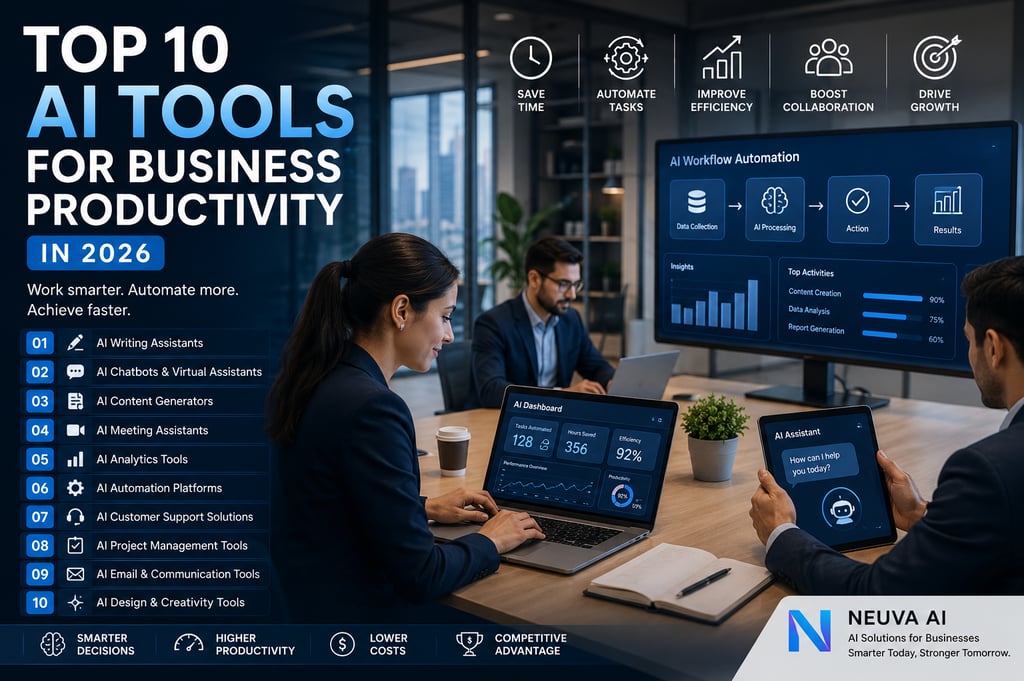
Top 10 AI Tools for Businesses in 2026
As businesses increasingly integrate artificial intelligence into their operations, several tools are set to redefine productivity in 2026. Here is a curated list of the top ten AI tools expected to be essential for enhancing operational efficiency and decision-making.
1. Salesforce Einstein – This AI-powered tool assists sales teams by providing in-depth customer insights and personalized recommendations. Its predictive analytics capabilities can drastically enhance marketing campaigns.
2. Microsoft Azure AI – A versatile cloud platform offering various AI services such as machine learning, computer vision, and natural language processing. It aids businesses in automating tasks and enhancing customer interactions.
3. Grammarly Business – Designed for team collaboration, it enhances workplace communication with AI-driven writing suggestions, ensuring that messaging is always clear and professional.
4. Zoom.ai – This virtual assistant simplifies scheduling and meeting organization, ultimately saving time for employees and improving productivity across teams.
5. HubSpot CRM – Incorporating AI functionalities, HubSpot helps businesses manage customer relationships through personalized marketing strategies and effective lead tracking.
6. DataRobot – An automated machine learning platform allowing businesses to create and deploy predictive models easily, facilitating data-driven decision-making processes.
7. Trello with Butler – This project management tool utilizes automation to streamline task management, allowing teams to focus on creative aspects rather than mundane administrative tasks.
8. IBM Watson – Known for its advanced natural language processing, Watson assists businesses in gaining insights from unstructured data, ideal for competitive analyses.
9. Hootsuite Insights – Using AI for social media management, Hootsuite helps businesses understand audience preferences through analytics and sentiment analysis.
10. Xero – This accounting tool deploys AI algorithms to automate tasks such as invoicing and reconciliation, freeing up time for accountants to engage in more strategic work.
To evaluate the effectiveness of these AI tools, businesses should consider their specific operational needs, integration capabilities, and the potential return on investment. Assessing customer testimonials and case studies can also provide valuable insights into real-world applications and help identify the most suitable tools for enhancing productivity.
Benefits of Implementing AI Tools in the Workplace
The integration of artificial intelligence (AI) tools into workplace operations offers a multitude of benefits that can significantly enhance business productivity. One of the primary advantages is the potential for substantial time and cost savings. By automating repetitive tasks such as data entry and scheduling, AI tools allow employees to focus on high-value activities that contribute more directly to the company's bottom line. For instance, a recent case study highlighted a marketing agency that implemented AI-driven analytics software, reducing reporting time by 40%, thereby reallocating those hours to creative strategy sessions.
Moreover, AI tools can increase accuracy in various processes. In sectors like finance and healthcare, algorithms analyze vast amounts of data with precision, thereby minimizing human error. This has been demonstrated in a leading healthcare provider's adoption of AI for diagnosing diseases, which resulted in a 30% increase in diagnostic accuracy, improving patient outcomes significantly.
Another notable benefit of employing AI tools is the enhancement of employee creativity. By automating tedious tasks, employees are empowered to engage more in innovative projects. A survey conducted by an industry research firm revealed that companies utilizing AI to streamline operations reported a 25% increase in employee satisfaction, as staff felt less constrained by mundane responsibilities.
Furthermore, AI tools facilitate superior data analysis, enabling organizations to leverage insights for strategic decision-making. For instance, retailers can utilize AI analytics to forecast inventory needs accurately, thereby reducing waste and increasing profitability. Lastly, the use of AI in customer service, such as chatbots, leads to quicker response times and improved customer satisfaction levels. A comprehensive review of customer interactions at a major retail chain indicated a 20% rise in customer loyalty after deploying AI chat solutions.
Practical Business Applications of AI Tools
AI tools are revolutionizing various industries, offering innovative solutions that enhance productivity and resolve complex challenges. One prominent application can be found in the marketing sector, where AI writing assistants are being utilized to streamline content creation. For instance, a marketing team could leverage AI tools to generate engaging blog posts, social media updates, or promotional materials efficiently. These tools use natural language processing algorithms to analyze target audiences, enabling companies to craft messages that resonate better, ultimately driving higher engagement rates.
In the financial industry, AI analytics tools play a critical role in data analysis and predictive modeling. By processing vast amounts of financial data at remarkable speeds, these tools help finance departments identify trends and anomalies with greater accuracy. A real-life example is Neuva AI, which assists finance teams by forecasting market movements, thereby enabling them to make informed investment decisions. This application exemplifies how AI can augment human capabilities, allowing financial analysts to focus more on strategy and less on routine data processing.
Furthermore, in the healthcare sector, AI tools are being used to streamline patient data management. By implementing AI-driven systems, hospitals and clinics can automate appointment scheduling, patient record management, and follow-up reminders. This not only reduces administrative burdens but also enhances patient care by ensuring timely medical assistance. For instance, AI chatbots can address patient inquiries, capturing essential information and directing them to appropriate healthcare professionals. The integration of AI in healthcare is not merely about reducing workload; it actively contributes to better health outcomes.
Future Trends in AI and Business Productivity
The rapid evolution of artificial intelligence (AI) technologies is reshaping business productivity across various sectors. One notable trend is the ascent of conversational AI, which is transforming customer interaction paradigms. Businesses are now leveraging chatbots and virtual assistants to provide real-time support and personalized experiences, thereby driving customer satisfaction and retention. As businesses prepare for this shift, investing in AI-driven communication tools will be crucial.
Additionally, the integration of machine learning with business intelligence systems is emerging as a powerful trend. By harnessing AI to analyze vast datasets, companies can derive actionable insights that inform strategic decisions. This convergence not only improves operational efficiencies but also enhances forecasting accuracy and market competitiveness. Organizations are advised to adopt machine learning solutions that align with their specific operational landscapes to maximize productivity gains.
Advancements in natural language processing (NLP) are also noteworthy, as they enable machines to understand and interpret human language with increasing sophistication. This capability allows businesses to automate documentation, analyze customer feedback, and improve internal communication channels. As companies look to the future, implementing NLP tools will be integral to streamlining workflows and enhancing collaboration.
Furthermore, ethical considerations surrounding AI utilization are gaining prominence. Organizations must navigate complex issues such as data privacy, algorithmic bias, and transparency to foster trust in AI applications. Proactive engagement with ethical frameworks will not only safeguard consumer interests but also bolster brand reputation in a competitive marketplace.
In conclusion, as emerging trends in AI technology continue to evolve, businesses must stay ahead of the curve by embracing these innovations. Fostering a culture of adaptability and ethical responsibility will pave the way for enhanced business strategies, ultimately driving productivity in the years to come.
Leveraging AI for Growth and Efficiency
Organizations looking to enhance their productivity through artificial intelligence must take systematic steps to ensure successful integration. Firstly, they should begin by assessing their current workflows to identify areas where AI can have the most significant impact. This assessment involves mapping out existing processes, pinpointing inefficiencies, and determining the specific tasks that could benefit from AI tools. Understanding these aspects will enable organizations to prioritize their AI initiatives effectively.
Once areas for improvement have been identified, it is crucial to select the right AI tools tailored to the organization's needs. Selecting an AI solution requires careful consideration of the capabilities of various tools in relation to identified workflows. Organizations should evaluate available options based on factors such as user-friendliness, scalability, and compatibility with existing systems. Engaging with vendors for demonstrations or pilot programs can also provide valuable insights into the practicality of the tools in real-world applications.
Training staff is a pivotal element in the successful adoption of AI tools. Employees must be equipped with the necessary skills to use these tools effectively, which may involve formal training sessions and ongoing support. Providing a comprehensive training program fosters a culture of openness towards AI and helps mitigate any resistance that may arise from employees who are unfamiliar with new technology. It is essential to ensure that all team members understand how AI can enhance their productivity and contribute to their overall success.
Measuring the impact of AI integration is another critical step for organizations. Implementing key performance indicators (KPIs) allows for tracking progress and assessing the effectiveness of the adopted AI tools. Regularly reviewing these metrics enables companies to make data-driven adjustments, ensuring that they continue to derive value from their AI investments.
Lastly, staying informed on developments in the field of AI is crucial. As technology evolves rapidly, organizations must adapt to remain competitive. Keeping abreast of new tools, techniques, and best practices in AI will allow companies to harness upcoming innovations that can further enhance productivity and drive growth.
Contact
Reach out to neuva ai for tailored AI solutions.
Phone
Connect@neuvaai.com
+91 9759115656
© 2026. All rights reserved @NeuvaAi.
Neuva AI provides AI-powered tools for education, business productivity and workplace automation.