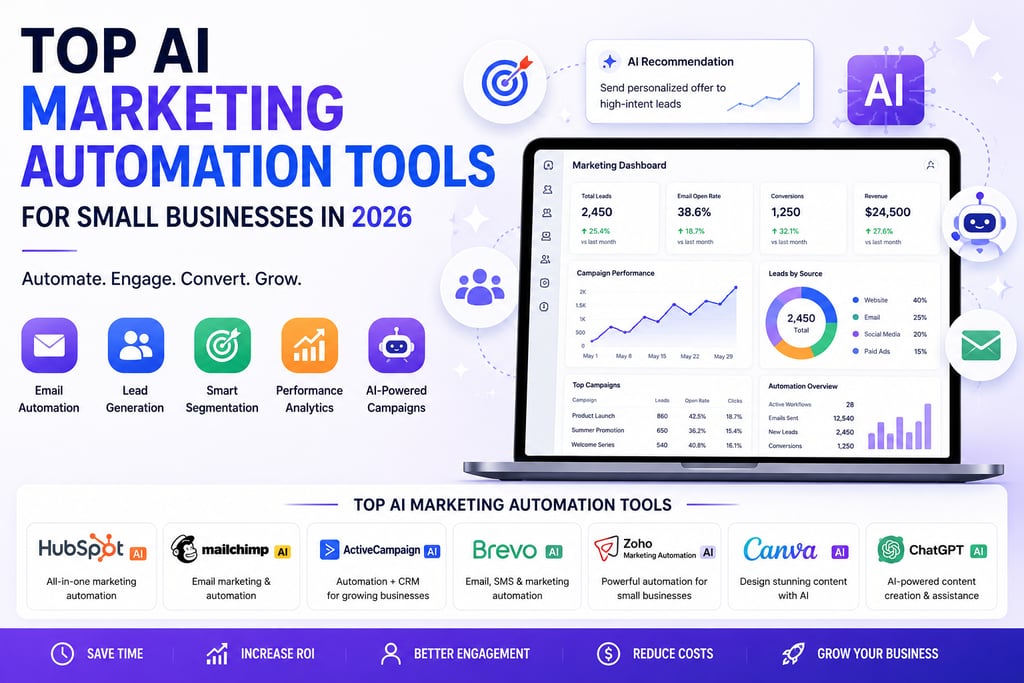
Top AI Marketing Automation Tools for Small Businesses in 2026
AI Marketing Automation Tools are helping small businesses automate campaigns, generate leads, improve customer engagement and increase conversions. From email automation and social media management to customer segmentation and analytics, these tools save time and improve marketing ROI. Explore the top AI marketing tools that businesses should consider in 2026.
BUSINESS AUTOMATION
Introduction to AI Marketing Automation Tools
AI marketing automation tools are revolutionary platforms designed to enhance and streamline various marketing processes by integrating artificial intelligence capabilities. Specifically, these tools utilize algorithms and data analysis to perform tasks that traditionally required intensive manual effort, thus allowing businesses to optimize their marketing strategies efficiently.
These innovative solutions encompass a broad range of functionalities, including email marketing, social media management, lead generation, and customer segmentation. For instance, in email marketing, AI tools can analyze customer behavior to create personalized campaigns that capture the target audience's attention, leading to increased engagement and better conversion rates.
When it comes to social media management, AI marketing automation tools can schedule posts, monitor engagement, and even respond to customer inquiries autonomously. This enables small businesses to maintain an active online presence without overwhelming their limited resources. In terms of lead generation, these tools employ predictive analytics to identify potential customers, allowing businesses to focus their efforts on high-quality leads that are more likely to convert.
Additionally, customer segmentation becomes more nuanced with AI tools, as they can analyze vast datasets to categorize customers based on demographics, behavior, and preferences. This deep understanding helps create targeted marketing campaigns that resonate with specific audience segments, ultimately leading to better customer experiences and loyalty.
The incorporation of AI into marketing strategies offers numerous benefits. Companies can save time and reduce operational costs while also enhancing the precision and effectiveness of their marketing efforts. As small businesses increasingly seek to leverage technology for competitive advantage, embracing AI marketing automation tools will likely become essential in driving growth and success in an ever-evolving digital landscape.
The Importance of Marketing Automation in 2026
As we approach the year 2026, the significance of marketing automation continues to grow, particularly for small businesses striving to stay competitive in an increasingly digital landscape. The rapid evolution of technology has resulted in a shift in consumer behavior, leading to the necessity for businesses to adapt their marketing strategies. Modern consumers expect personalized communications and swift service, which marketing automation can facilitate through personalized email campaigns, targeted social media ads, and effective data analytics.
Furthermore, the integration of artificial intelligence (AI) into marketing automation tools enables small businesses to gather insights from consumer data, optimizing marketing strategies effectively. For instance, AI algorithms can analyze customer interactions and purchase histories, giving businesses the ability to segment their audience better and tailor their messaging accordingly. This level of personalization not only enhances customer satisfaction but also drives conversions, a crucial factor for smaller enterprises with limited resources.
Statistical projections indicate that by 2026, the global marketing automation market will surpass $7 billion, which underscores the growing recognition of such tools in enhancing efficiency and effectiveness. As more businesses embrace these technologies, it becomes imperative for small businesses to adopt marketing automation to maintain competitive parity. In 2026, businesses that fail to leverage smart automation tools risk falling behind their competitors who utilize AI-driven insights to refine their marketing efforts.
Ultimately, the importance of marketing automation lies in its capacity to streamline operations, provide valuable insights, and enhance overall customer engagement. As technology continues to advance, embracing marketing automation is not merely an option for small businesses; it is a strategic necessity that will define success in the years to come.
Top AI Marketing Automation Tools
In 2026, small businesses benefit significantly from the adoption of advanced marketing strategies, particularly through the implementation of AI marketing automation tools. These tools help streamline operations, enhance customer engagement, and improve overall marketing efficacy. Among the leaders in this space are several notable platforms, each offering distinct features tailored to various marketing needs.
HubSpot AI is well-regarded for its comprehensive inbound marketing capabilities. Its AI-driven features simplify lead generation, customer relationship management, and content marketing, making it an optimal choice for small businesses seeking to cultivate relationships and drive conversions effectively.
Mailchimp AI focuses primarily on email marketing automation, providing users with tools that include predictive segmentation and personalized content recommendations. Its user-friendly interface and robust analytics make it a fitting solution for small enterprises aiming to enhance their email campaigns and improve engagement rates.
ActiveCampaign serves a diverse array of marketing needs with its powerful automation features encompassing email marketing, CRM, and customer experience automation. The platform is particularly useful for small businesses that wish to integrate their marketing efforts seamlessly across various channels.
Brevo, formerly known as Sendinblue, is an all-in-one platform that aids businesses in email marketing, SMS campaigns, and CRM management. Its affordability and ease of use make it suitable for small businesses with limited budgets looking to expand their outreach.
Zoho Marketing Automation offers a suite of tools designed for workflow automation, campaign management, and analytics. This tool is advantageous for businesses seeking tailored marketing solutions without overwhelming complexity.
Canva AI, known for its design capabilities, has integrated marketing automation features that assist small businesses in creating visually appealing marketing materials effortlessly. Combining design and marketing will enhance brand visibility and engagement.
Lastly, ChatGPT can transform customer interactions by providing real-time customer support and feedback, thus enhancing the dialogue between businesses and their clientele. This tool can significantly improve customer satisfaction and retention.
These AI marketing automation tools collectively represent a powerful arsenal for small businesses aiming to optimize their marketing efforts in 2026. Each platform presents unique advantages that cater to diverse marketing needs, paving the way for efficient strategies and enhanced growth potential.
Key Features of Each Tool
In the rapidly evolving landscape of small business marketing, effective automation tools are essential for driving engagement and enhancing productivity. Various AI marketing automation tools come equipped with a unique set of features that significantly contribute to the success of marketing campaigns. One of the primary capabilities of these tools is their automation functionality, which allows businesses to streamline repetitive tasks such as email marketing, social media posting, and lead nurturing. For example, tools like HubSpot offer advanced marketing automation that enables users to create sophisticated workflows that respond to customer behaviors.
Integration with other platforms is another critical feature that enhances the effectiveness of AI marketing tools. Solutions like Salesforce Marketing Cloud easily connect with various CRM and analytics platforms, ensuring that businesses can compile and utilize data from multiple sources effortlessly. This integration capability not only saves time but also facilitates a more comprehensive understanding of customer interactions across different channels.
The user interface (UI) of marketing automation tools is paramount for ensuring that users can navigate the platform with ease. A well-designed UI reduces the learning curve for small business owners who may not have extensive technical expertise. For instance, platforms like Mailchimp are recognized for their intuitive design, making it straightforward for users to create campaigns and analyze their performance.
Reporting and analytics tools in these automation solutions provide deep insights into campaign effectiveness. Features such as real-time data tracking enable businesses to adjust strategies promptly. Customization options play a significant role in meeting specific business needs; tools like ActiveCampaign allow users to tailor their marketing messages and workflows to fit the unique demands of their target audience. Overall, these features distinguish each tool in a crowded marketplace, making them invaluable for small businesses looking to leverage AI for marketing success.
Pricing and Free Plan Information
Understanding the pricing structures of AI marketing automation tools is crucial for small businesses seeking to integrate these technologies efficiently. Each tool reviewed presents a distinct subscription model alongside varying features that appeal to different business needs.
For example, Tool A offers a tiered subscription plan with three levels: Basic, Professional, and Enterprise. The Basic plan starts at $15 per month, suitable for small teams with essential features such as email marketing and social media management. The Professional plan, priced at $45 per month, adds advanced analytics and customizable templates, while the Enterprise plan, at $99 per month, makes available unlimited campaigns and prioritized support. Importantly, Tool A allows users to explore its full capabilities through a 14-day free trial for the Professional and Enterprise plans.
Similarly, Tool B adopts a different approach with a pay-as-you-go model, charging $0.10 per contact each month. This flexibility is particularly beneficial for businesses with fluctuating customer bases. Tool B also offers a free tier that includes core functionalities, catering to startups that are cautious with their budgeting, though it limits the number of automated campaigns.
In contrast, Tool C adopts a flat fee structure, starting at $30 per month with no user limits. This plan includes various features like basic automation workflows and reporting capabilities. A notable aspect of Tool C is its forever-free plan, which is a great option for small businesses just starting their marketing automation journey.
Overall, the value proposition of upgraded plans generally hinges on enhanced features and customer support, which small businesses should weigh against their budget constraints and growth potential. By carefully analyzing the pricing and free plan options of each tool, businesses can strategically select an AI marketing automation tool that fits their unique needs.
Comparison of AI Marketing Automation Tools
In the landscape of small business marketing, AI marketing automation tools have emerged as vital resources, offering a range of features that streamline and enhance marketing efforts. The following comparison summarizes key aspects of various AI marketing automation tools available to small businesses in 2026, taking into account features, pricing, and unique selling propositions.
1. Tool A
Features: Automated email marketing, personalized customer targeting, analytics dashboard.
Pricing: $30/month with a free trial available.
Unique Selling Point: Highly user-friendly interface suitable for beginners.
2. Tool B
Features: Social media automation, lead scoring, multi-campaign management.
Pricing: $50/month with tiered pricing for larger teams.
Unique Selling Point: Integrates seamlessly with major social media platforms.
3. Tool C
Features: Customer relationship management, marketing analytics, targeted ads.
Pricing: $40/month with a one-month free trial for new users.
Unique Selling Point: Offers advanced analytics for data-driven decision making.
4. Tool D
Features: Website personalization, chatbot integration, performance tracking.
Pricing: $25/month with flexible annual billing.
Unique Selling Point: Focuses on website engagement through innovative technologies.
By reviewing these detailed aspects, small business owners can easily ascertain which AI marketing automation tool aligns best with their specific needs and budget constraints. The visual format allows for quick comparisons, aiding in strategic decision-making and effective marketing automation implementation for small enterprises.
Choosing the Right Tool for Different Business Sizes
When selecting AI marketing automation tools, it is essential to consider the specific needs of your business size. Startups and established small businesses may require different features, pricing models, and scalability options. Understanding these differences can help prioritize the right tools that align with your business objectives.
For startups, budget constraints are often a significant factor. Tools that offer free trials or tiered pricing can be particularly beneficial. These options allow startups to test functionalities without heavy financial commitments. Typically, they require user-friendly interfaces with essential features such as email marketing, basic analytics, and social media integration. Starting with a simpler tool can provide startups with fundamental insights into customer engagement, paving the way for advanced functionalities as they grow.
In contrast, established small businesses often benefit from more comprehensive AI marketing automation solutions. These businesses generally have a broader scope and may require advanced features such as detailed analytics, customer segmentation, and integration with various platforms. Tools tailored for these businesses should support scalability, enabling them to accommodate increased data volume and complex marketing campaigns without sacrificing performance.
It's also imperative to consider adaptability. Businesses that anticipate significant growth or changes in marketing strategy should prioritize software that easily integrates with other systems and evolves with their requirements. Look for tools that offer customizable features or have a modular approach, allowing businesses to add functionalities as needed. Additionally, ensure that the selected tools provide robust customer support and training resources to maximize their effectiveness.
Ultimately, by carefully considering the specific requirements based on business size, marketers can select AI marketing automation tools that not only meet their current needs but also support their growth and evolution over time.
FAQs about AI Marketing Automation Tools
As small businesses increasingly adopt AI marketing automation tools, several questions arise regarding their functionality, effectiveness, and compatibility with existing systems. Here, we address five of the most frequently asked questions to provide clarity on this transformative technology.
1. Are AI marketing automation tools compatible with existing marketing systems?
Yes, most AI marketing automation tools are designed to integrate seamlessly with various marketing platforms. Whether you're using customer relationship management (CRM) systems or social media management tools, these solutions typically offer APIs or integrations that facilitate interoperability. This ensures that businesses can leverage AI capabilities without overhauling their existing setups.
2. How steep is the learning curve for using these tools?
The learning curve for AI marketing automation tools can vary based on the complexity of the software and the user's prior experience with marketing technologies. Generally, many tools offer user-friendly interfaces and extensive documentation that can help ease the onboarding process. In addition, many providers offer training sessions and support to enhance user familiarity.
3. How important is data privacy when using AI marketing automation tools?
Data privacy is paramount when implementing AI marketing automation tools. These systems often handle sensitive customer data, and companies must ensure compliance with relevant regulations such as GDPR or CCPA. Reputable vendors typically provide robust security measures and privacy controls, allowing businesses to responsibly manage data while maximizing the effectiveness of their marketing campaigns.
4. What impact do these tools have on marketing ROI?
AI marketing automation tools can significantly enhance marketing ROI by optimizing campaigns, improving customer segmentation, and providing actionable insights through analytics. By automating repetitive tasks, businesses can focus on strategic decision-making, ultimately leading to higher engagement rates and improved conversion metrics.
5. What does the future hold for AI in marketing?
The future of AI in marketing appears promising, with forecasts indicating increased innovation and automation. As artificial intelligence continues to evolve, small businesses can expect more advanced features, including predictive analytics and personalized customer experiences. Embracing these advancements is essential for staying competitive in an increasingly digital marketplace.
NeuVa AI and Other AI Marketing Automation Solutions
NeuVa AI stands out among the myriad AI marketing automation tools available in 2026, particularly due to its innovative feature set tailored for small business needs. Unlike traditional platforms, NeuVa incorporates advanced machine learning algorithms that analyze customer behavior in real-time, enabling businesses to tailor their marketing strategies with precision. This dynamic adaptability not only enhances customer engagement but also improves conversion rates significantly. NeuVa's user-friendly interface allows marketers to implement complex campaigns without requiring extensive technical knowledge, making it especially appealing for smaller enterprises with limited resources.
In addition to real-time analytics, NeuVa AI offers an assimilation of multi-channel marketing capabilities. This means that marketers can manage email, social media, and other digital marketing channels from a single dashboard, streamlining operations and ensuring consistency across campaigns. The automated reporting feature provides insights on campaign performance, allowing businesses to make data-driven decisions swiftly. NeuVa also distinguishes itself by offering personalized customer interactions powered by AI, which helps create tailored experiences that resonate with target audiences.
While NeuVa AI is a leading contender in the realm of marketing automation, several other emerging solutions are also making their mark. For instance, platforms like HubSpot and Mailchimp are integrating AI functionalities that simplify customer segmentation and campaign optimization. Similarly, newer entrants like SmartBot and MarketLion emphasize enhanced personalization and predictive analytics, catering to the rising demand for targeted marketing efforts. As the landscape of marketing automation continues to evolve, it is crucial for small businesses to explore these options and find tools that align best with their unique marketing objectives. The combination of robust features, ease of use, and affordability remains essential criteria for selecting an effective AI marketing automation tool.
Conclusion and Call to Action
As we progress into 2026, the integration of AI marketing automation tools remains paramount for small businesses aiming to enhance their marketing strategies. Throughout this blog post, we have identified several key tools that can significantly transform your marketing efforts by streamlining processes, improving customer engagement, and providing actionable insights. The importance of selecting the right AI marketing automation tools cannot be overstated; they serve as the backbone of a successful, data-driven marketing strategy.
Among the AI tools discussed, tools that offer personalized content recommendations, customer segmentation, and analytics capabilities stand out as essential for small businesses. These functionalities enable businesses to not only reach a wider audience but also engage more meaningfully with their existing customer base. By leveraging such tools, small businesses can maximize their marketing effectiveness while minimizing wasted resources.
We encourage you to evaluate your current marketing needs critically. Consider the various features offered by the AI marketing automation tools highlighted in this post and analyze how they align with your business goals. The transition to a more automated marketing approach may seem daunting, but embracing these technologies can lead to significant improvements in efficiency and engagement.
In light of this information, take proactive steps toward implementing an AI marketing automation solution that meets your unique requirements. Research and trial different tools to find the best fit for your organization. Remember, the right strategy in selecting and utilizing AI tools not only boosts productivity but also positions your small business for growth in an increasingly competitive market. Start today and witness the transformation in your marketing success.
Internal Links
Contact
Reach out to neuva ai for tailored AI solutions.
Phone
Connect@neuvaai.com
+91 9759115656
© 2026. All rights reserved @NeuvaAi.
Neuva AI provides AI-powered tools for education, business productivity and workplace automation.